
⏱️ 5 min read
The animal kingdom is filled with remarkable displays of intelligence that challenge our understanding of cognitive abilities beyond humans. From problem-solving and tool use to complex communication and self-awareness, animals across diverse species demonstrate sophisticated mental capabilities that continue to fascinate scientists and nature enthusiasts alike. These intelligent behaviors reveal that cognition exists on a broad spectrum throughout the natural world, with many creatures exhibiting skills once thought to be uniquely human.
Tool Creation and Manipulation
One of the most striking indicators of animal intelligence is the ability to create and use tools for specific purposes. New Caledonian crows have become famous for their sophisticated tool-making abilities, fashioning hooks from twigs and using them to extract insects from tree bark. These birds don’t simply use found objects; they actually modify materials to create more effective tools, demonstrating foresight and understanding of cause and effect.
Chimpanzees and other great apes have long been observed using tools in various contexts. They use stones to crack nuts, fashion spears for hunting, and employ leaves as sponges to collect water. What makes this behavior particularly remarkable is that these skills are passed down through generations, creating distinct cultural traditions within different populations.
Sea otters provide an aquatic example of tool use, carrying favorite rocks in the pouches of skin under their forearms. They use these rocks as anvils to crack open shellfish while floating on their backs, demonstrating not only tool use but also the foresight to keep preferred tools for future use.
Complex Problem-Solving Abilities
Octopuses display extraordinary problem-solving skills that seem almost alien given their evolutionary distance from vertebrates. These cephalopods can navigate mazes, open jars with screw-top lids, and have been observed carrying coconut shell halves to use as portable shelters. Their ability to solve novel problems suggests a sophisticated understanding of their environment and the capacity for flexible thinking.
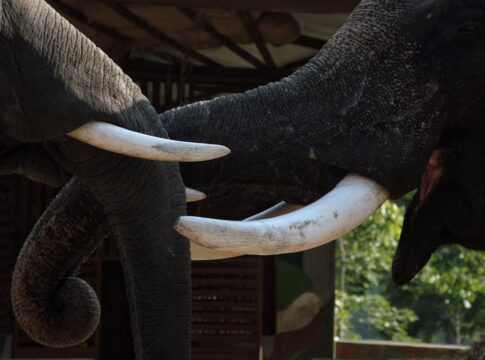
Elephants demonstrate remarkable problem-solving in both captive and wild settings. They’ve been observed dropping logs onto electric fences to break the circuit, cooperating to retrieve out-of-reach food, and even showing an understanding of weight and volume when choosing tools. Their problem-solving often involves social cooperation, highlighting the interconnection between intelligence and social behavior.
Dolphins regularly display innovative problem-solving techniques. They use marine sponges as protective gloves while foraging on the seafloor, demonstrating tool use in an aquatic environment. Additionally, they create mud rings to trap fish and work cooperatively to herd prey, showing both individual ingenuity and collective intelligence.
Self-Awareness and Mirror Recognition
The ability to recognize oneself in a mirror is considered a significant indicator of self-awareness and higher cognitive function. Great apes, including chimpanzees, orangutans, and gorillas, consistently pass the mirror self-recognition test, often using mirrors to inspect parts of their bodies they cannot normally see.
Surprisingly, dolphins and some whale species also demonstrate mirror self-recognition, using reflections to examine marks placed on their bodies. This ability in marine mammals suggests that self-awareness evolved independently in different lineages, indicating its importance as a cognitive trait.
Elephants have also passed mirror tests, and magpies are among the few non-mammal species to show this capability. The presence of self-recognition across such diverse species suggests that intelligence and self-awareness have multiple evolutionary origins.
Advanced Communication Systems
Prairie dogs possess one of the most sophisticated animal communication systems discovered to date. Research has shown that their alarm calls contain specific information about predator type, size, color, and even speed of approach. This linguistic complexity allows colony members to respond appropriately to different threats, demonstrating abstract thought and descriptive ability.
Honeybees perform elaborate waggle dances to communicate the distance, direction, and quality of food sources to hive mates. This symbolic communication system can convey information about locations several kilometers away, representing a remarkable form of abstract information transfer in insects.
Parrots, particularly African grey parrots, can learn human vocabulary and use words appropriately in context. The famous parrot Alex demonstrated the ability to identify colors, shapes, and quantities, and could combine concepts in novel ways, suggesting genuine understanding rather than mere mimicry.
Emotional Intelligence and Empathy
Elephants display profound emotional intelligence, mourning their dead and showing what appears to be genuine grief. They revisit bones of deceased family members and have been observed standing vigil over deceased companions. This emotional depth suggests complex inner lives and social awareness.
Rats demonstrate empathy by freeing trapped companions even when there’s no benefit to themselves. In experiments, rats will forgo chocolate rewards to help a distressed cage mate, showing that empathetic behavior extends well beyond primates and may be more widespread than previously thought.
Dolphins have been documented supporting injured or ill pod members, holding them near the surface to help them breathe. This caregiving behavior requires recognition of another’s distress and the motivation to provide assistance, fundamental components of empathy.
Memory and Future Planning
Clark’s nutcrackers cache thousands of pine seeds across vast territories and can remember the locations of these stores for months. This spatial memory capability is extraordinary, requiring the birds to create detailed mental maps and recall specific locations among countless possible sites.
Chimpanzees and other great apes show clear evidence of planning for future needs. Captive chimpanzees have been observed collecting and hiding stones before zoo opening, later using them as projectiles toward visitors, demonstrating premeditation and delayed gratification.
Western scrub jays not only cache food but also adjust their caching behavior based on whether other birds were watching. If observed, they’ll later move their caches to new locations, showing awareness of others’ knowledge states and future-oriented deception.
These remarkable behaviors across diverse species demonstrate that intelligence is not a uniquely human trait but rather exists along a continuum throughout the animal kingdom. Understanding these capabilities not only deepens our appreciation for animal life but also raises important ethical questions about how we interact with and protect these cognitively sophisticated creatures.