
⏱️ 7 min read
The ancient world was home to remarkable civilizations that laid the foundations for modern society. From groundbreaking technological innovations to sophisticated governmental systems, these early cultures shaped human development in ways that continue to influence us today. Understanding these civilizations provides crucial insight into the evolution of human organization, culture, and progress. The following exploration examines ten pivotal ancient civilizations that left indelible marks on human history.
The Cradles of Human Civilization
1. Mesopotamia: The Birthplace of Writing and Law
Mesopotamia, meaning “land between rivers,” flourished between the Tigris and Euphrates rivers in modern-day Iraq from approximately 3500 BCE. This civilization is credited with numerous firsts in human history, including the invention of cuneiform writing around 3200 BCE, making it one of the earliest writing systems ever developed. The Mesopotamians established the first known cities, including Uruk, Ur, and Babylon, creating urban centers that housed thousands of inhabitants.
The Code of Hammurabi, dating to around 1754 BCE, represents one of humanity’s earliest legal codes, establishing laws and punishments that influenced subsequent legal systems. Mesopotamians also made significant advances in mathematics, developing a base-60 number system that survives today in how we measure time and angles. Their astronomical observations and agricultural innovations, including advanced irrigation systems, enabled sustained population growth and cultural development.
2. Ancient Egypt: Masters of Monumental Architecture
Ancient Egyptian civilization emerged along the Nile River around 3100 BCE and endured for over three millennia. The Egyptians are renowned for their architectural marvels, particularly the pyramids of Giza, which demonstrate extraordinary engineering capabilities and organizational prowess. The Great Pyramid of Khufu remained the world’s tallest man-made structure for approximately 3,800 years.
Egyptian contributions extended beyond architecture to include advancements in medicine, mathematics, and art. They developed one of the earliest forms of writing, hieroglyphics, and created papyrus, an early form of paper. Their religious beliefs in the afterlife led to sophisticated mummification techniques and elaborate burial practices. The Egyptian administrative system, with its complex bureaucracy and taxation methods, provided a model for governing large populations across extensive territories.
3. The Indus Valley Civilization: Urban Planning Pioneers
Flourishing from approximately 3300 to 1300 BCE in present-day Pakistan and northwest India, the Indus Valley Civilization demonstrated remarkable urban planning capabilities. Cities like Mohenjo-daro and Harappa featured grid-pattern streets, advanced drainage systems, and standardized brick sizes, indicating sophisticated central planning and engineering knowledge.
This civilization developed standardized weights and measures, facilitating trade across vast distances. Archaeological evidence suggests a relatively egalitarian society with little sign of warfare or rigid class hierarchies. The Indus script, though still undeciphered, appears on numerous seals and artifacts, indicating a developed system of record-keeping and communication. Their decline remains mysterious, possibly due to climate change or shifts in river patterns.
4. Ancient China: Innovation and Imperial Power
Chinese civilization traces its roots to the Yellow River Valley around 2070 BCE with the legendary Xia Dynasty, though the historically confirmed Shang Dynasty began around 1600 BCE. Ancient China contributed numerous innovations that transformed human civilization, including paper, gunpowder, the compass, and printing technology.
The construction of the Great Wall, begun during the Qin Dynasty, represents one of history’s most ambitious defensive projects. Chinese philosophy, particularly Confucianism and Taoism, profoundly influenced ethical thinking and governance throughout Asia. The imperial examination system created a meritocratic bureaucracy that administered vast territories efficiently. Chinese achievements in astronomy, mathematics, and agriculture supported population growth and cultural flourishing that continues to this day.
5. Ancient Greece: The Foundation of Western Philosophy
Ancient Greek civilization, flourishing from approximately 800 to 146 BCE, fundamentally shaped Western intellectual tradition. Athens pioneered democratic governance, creating systems of citizen participation that inspired modern democracies. Greek philosophers including Socrates, Plato, and Aristotle established methodologies of logical reasoning and inquiry that remain central to Western thought.
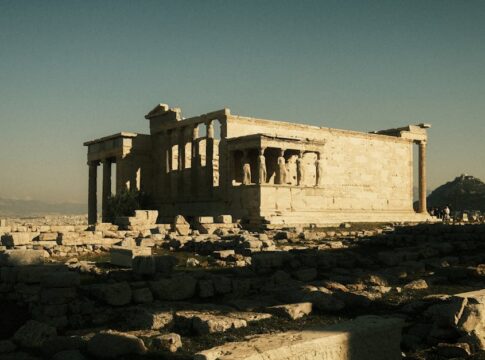
Greek contributions to mathematics, particularly geometry through figures like Euclid and Pythagoras, provided frameworks still used today. Their architectural achievements, exemplified by the Parthenon, established aesthetic principles that influenced building design for millennia. Greek drama, literature, and mythology created narrative traditions and artistic forms that continue to resonate throughout global culture.
6. The Roman Empire: Engineering and Legal Excellence
The Roman Empire, spanning from 27 BCE to 476 CE in the West, created one of history’s most extensive and enduring political entities. Roman engineering prowess produced remarkable structures including aqueducts, roads, and buildings, many of which survive today. The Roman road network facilitated communication and trade across their vast empire, while their concrete technology enabled architectural innovations.
Roman law established legal principles that form the basis of many modern legal systems, including concepts of civil rights and legal procedure. The Latin language influenced the development of Romance languages and remains important in scientific and legal terminology. Roman administrative systems provided templates for organizing large territories and diverse populations under centralized authority.
7. The Maya Civilization: Astronomical and Mathematical Genius
The Maya civilization of Mesoamerica, flourishing from approximately 2000 BCE to 900 CE, achieved extraordinary sophistication in astronomy, mathematics, and architecture. The Maya developed a complex calendar system more accurate than the contemporary Julian calendar, demonstrating advanced astronomical knowledge. They independently invented the concept of zero, a crucial mathematical innovation.
Maya architectural achievements include stepped pyramids, palaces, and observatories throughout present-day Mexico, Guatemala, and Honduras. Their hieroglyphic writing system represents one of the most sophisticated pre-Columbian scripts. Maya city-states developed complex political systems and engaged in extensive trade networks, creating a vibrant cultural sphere that influences the region today.
8. The Persian Empire: Cultural Tolerance and Imperial Administration
The Persian Empire, particularly under the Achaemenid Dynasty (550-330 BCE), created one of antiquity’s largest empires, stretching from Egypt to India. The Persians pioneered concepts of religious and cultural tolerance, allowing conquered peoples to maintain their traditions while incorporating them into the imperial system. This approach facilitated stable governance across diverse populations.
The Royal Road, stretching over 1,600 miles, enabled efficient communication and trade throughout the empire. Persian contributions to art, architecture, and garden design influenced subsequent Islamic and European traditions. The administrative system established by Cyrus the Great and refined by Darius I provided models for managing vast territories through provincial governors and standardized administration.
9. The Phoenicians: Maritime Trade and the Alphabet
The Phoenician civilization, based in modern-day Lebanon from approximately 1500 to 300 BCE, dominated Mediterranean maritime trade. Their seafaring expertise enabled the establishment of trading posts and colonies throughout the Mediterranean, including Carthage, which became a major power. Phoenician merchants traded goods including purple dye, timber, and glassware across vast distances.
The Phoenicians’ most significant contribution was developing the phonetic alphabet around 1050 BCE, which became the ancestor of Greek, Latin, and ultimately most modern alphabets. This simplified writing system made literacy more accessible compared to complex pictographic systems. Their shipbuilding techniques and navigational skills enabled Mediterranean exploration and cultural exchange.
10. The Inca Empire: Architectural Mastery in the Mountains
The Inca Empire, flourishing from 1438 to 1533 CE in South America, created the largest pre-Columbian empire in the Americas. Without wheeled vehicles or iron tools, the Incas constructed remarkable stone structures, including Machu Picchu, using precisely cut stones that fit together without mortar. Their road system, spanning over 25,000 miles through challenging mountain terrain, facilitated communication and trade.
The Incas developed sophisticated agricultural techniques including terracing and irrigation systems that supported large populations in difficult environments. Their quipu system, using knotted strings, served as a method of record-keeping and communication. The Inca administrative system efficiently governed diverse peoples across vast distances, demonstrating remarkable organizational capabilities.
The Lasting Legacy of Ancient Civilizations
These ten ancient civilizations collectively established foundations for modern society in governance, law, engineering, agriculture, writing, and philosophy. Their innovations addressed fundamental human challenges and created systems that subsequent cultures adapted and refined. From Mesopotamian legal codes to Greek philosophy, from Roman engineering to Chinese innovations, these civilizations demonstrated human ingenuity and organizational capability. Understanding their achievements provides perspective on human development and reminds us that contemporary society builds upon millennia of accumulated knowledge and experience. The legacy of these ancient peoples continues to shape our world, making their study essential for comprehending both our past and present.