
⏱️ 7 min read
Michelangelo Buonarroti stands as one of history’s most remarkable artistic geniuses, whose works continue to captivate audiences more than five centuries after their creation. While most people recognize his name and his masterpieces like the Sistine Chapel ceiling and the statue of David, the life and career of this Renaissance master contained numerous fascinating details that often remain unknown. From his unconventional working methods to his complex personality and hidden talents, Michelangelo’s story reveals a multifaceted individual whose influence extended far beyond the marble and paint that made him famous.
Extraordinary Facts About the Renaissance Master
1. He Considered Himself a Sculptor First and Foremost
Despite creating some of the most celebrated paintings in human history, Michelangelo always identified himself primarily as a sculptor. He viewed sculpture as the supreme art form and often expressed reluctance when commissioned to paint. When Pope Julius II commanded him to paint the Sistine Chapel ceiling, Michelangelo initially resisted, insisting he was a sculptor, not a painter. He even signed his letters as “Michelangelo, sculptor” and believed that working with marble brought him closest to revealing the divine forms hidden within the stone.
2. His Nose Was Broken in a Fistfight as a Teenager
The distinctive profile seen in portraits of Michelangelo resulted from a violent encounter during his youth. At around age seventeen, while studying in the Medici gardens, Michelangelo got into an argument with fellow sculptor Pietro Torrigiano. The dispute escalated, and Torrigiano punched Michelangelo in the face, crushing his nose. This disfigurement remained with him for life and reportedly caused him considerable embarrassment, though it became one of his most recognizable physical characteristics.
3. He Rarely Bathed and Slept in His Clothes
Michelangelo’s dedication to his work bordered on obsessive, often at the expense of personal hygiene and comfort. Historical accounts describe how he would work for days without removing his clothes or boots, sometimes sleeping in them. He ate sparingly and irregularly, viewing bodily needs as distractions from his artistic pursuits. According to his biographer Ascanio Condivi, when Michelangelo finally removed his boots after extended periods, skin would sometimes come off with them. This extreme devotion to his craft contributed to various health problems throughout his life.
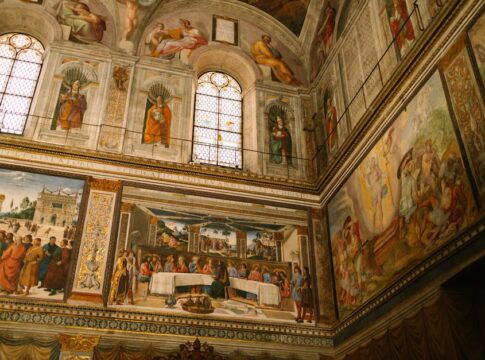
4. He Painted the Sistine Chapel Ceiling Standing Up, Not Lying Down
Contrary to popular belief perpetuated by films and general imagination, Michelangelo did not paint the Sistine Chapel ceiling while lying on his back. He designed a special scaffolding system that allowed him to stand upright while painting overhead. However, this didn’t make the task any less physically demanding. He worked with his head tilted back at an extreme angle for hours, which caused severe neck and back pain. Michelangelo even wrote a humorous poem describing the physical toll, noting how paint dripped onto his face and how his body contorted into uncomfortable positions.
5. He Never Married and Left His Personal Life Mysterious
Throughout his eighty-eight years, Michelangelo never married or had children, dedicating his life almost entirely to his art. His personal relationships and romantic inclinations have been subjects of scholarly debate for centuries. He wrote passionate poetry to various individuals, most notably to Tommaso dei Cavalieri, a young Roman nobleman, and to Vittoria Colonna, a noblewoman and poet. These writings reveal a deeply emotional and spiritual individual who channeled much of his passion into artistic expression rather than conventional domestic life.
6. He Created Fake Antiques to Deceive Art Collectors
Early in his career, Michelangelo demonstrated both his remarkable skill and his cunning by creating sculptures designed to look like ancient Roman artifacts. His sculpture “Sleeping Cupid” was artificially aged and sold as a genuine antiquity to Cardinal Riario of San Giorgio. When the deception was discovered, rather than facing consequences, Michelangelo’s reputation actually benefited. The cardinal was so impressed by the young artist’s ability to replicate classical style that he invited Michelangelo to Rome, launching his career on a larger stage.
7. He Completed the David Statue from Rejected Marble
The iconic seventeen-foot statue of David was carved from a massive block of Carrara marble that had been abandoned by two other sculptors who deemed it too difficult to work with. The marble had been extracted forty years earlier and had a visible flaw running through it. At age twenty-six, Michelangelo accepted the challenge that others had rejected. Working in complete secrecy for over two years, he transformed this “rejected” stone into what many consider the greatest sculpture ever created, demonstrating his unparalleled technical skill and artistic vision.
8. He Was Exceptionally Wealthy but Lived Like a Pauper
Despite earning enormous sums from his commissions and owning substantial property, Michelangelo lived an austere existence. He dressed in simple, often worn-out clothes and ate minimal meals, sometimes just bread and wine. His nephew later discovered that Michelangelo had accumulated significant wealth, including property holdings and substantial bank accounts. This contradiction between his means and his lifestyle reflected his philosophy that worldly possessions were distractions from spiritual and artistic pursuits.
9. He Hid Self-Portraits Within His Masterpieces
Michelangelo incorporated hidden self-portraits into several of his works in creative and sometimes disturbing ways. Most famously, in the Sistine Chapel’s “Last Judgment,” he painted his own face onto the flayed skin held by Saint Bartholomew, perhaps reflecting his own spiritual anguish or his feeling of being figuratively “flayed alive” by harsh criticism. These hidden signatures demonstrate his complex personality and his tendency toward self-reflection, even within works created for the glory of God and his patrons.
10. He Designed Fortifications and Worked as a Military Engineer
Beyond his artistic achievements, Michelangelo possessed remarkable architectural and engineering skills that he applied to military purposes. During the Siege of Florence in 1529, he served as the director of fortifications, designing defensive structures to protect his beloved city. His innovative designs demonstrated sophisticated understanding of military strategy and structural engineering, proving that his genius extended beyond aesthetic creation into practical applications that could mean the difference between victory and defeat.
11. He Lived Through Thirteen Different Popes
Michelangelo’s extraordinarily long life and career spanned the reigns of thirteen popes, from Sixtus IV to Pius IV. He worked directly for several of them, including Julius II, Leo X, Clement VII, and Paul III. This longevity allowed him to witness and contribute to dramatic changes in art, religion, and politics during the High Renaissance and into the Counter-Reformation. Each papal relationship brought different challenges and opportunities, shaping both his artistic output and his personal fortune.
12. He Wrote Hundreds of Poems That Went Unpublished During His Lifetime
Few people know that Michelangelo was also an accomplished poet who wrote over three hundred poems throughout his life. These sonnets and madrigals explored themes of divine love, human beauty, artistic creation, and spiritual longing. Though he shared them privately with friends and considered publishing them, no collection appeared during his lifetime. His poetry reveals the intellectual and emotional depth behind his visual masterpieces, showing a man who expressed himself eloquently through both chisel and pen.
The Lasting Legacy of a Complex Genius
These twelve fascinating aspects of Michelangelo’s life reveal a figure far more complex and human than the idealized image of the divine artist often portrayed in history books. From his humble living conditions despite great wealth to his multiple talents spanning sculpture, painting, architecture, engineering, and poetry, Michelangelo embodied the Renaissance ideal of the complete human being. His obsessive dedication, personal quirks, and passionate nature all contributed to creating works that continue to move viewers centuries after his death in 1564. Understanding these lesser-known facts about his life enriches our appreciation of his masterpieces, reminding us that behind every great work of art stands a fully dimensional human being with strengths, weaknesses, and contradictions that make their achievements all the more remarkable.