







⏱️ 10 min read
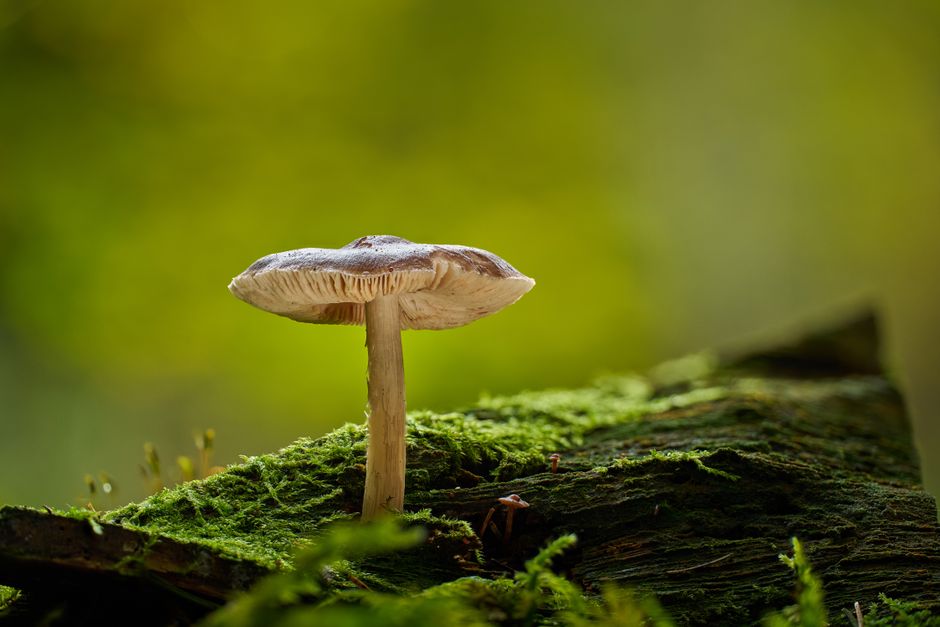
For most of human history, fungi were lumped together with plants in scientific classification, treated as little more than peculiar vegetables sprouting from soil and tree bark. This comfortable assumption crumbled in the 1990s when genetic sequencing revealed a startling truth: the mushrooms in your grocery store share more evolutionary history with you than with the lettuce sitting beside them.
Quick Facts
- Fungi and animals diverged from their last common ancestor approximately 1.5 billion years ago, while plants split off even earlier.
- Both fungi and animals store energy as glycogen, while plants use starch as their primary carbohydrate reserve.
- Fungi possess chitin in their cell walls, the same structural polymer found in insect exoskeletons and crustacean shells.
- Unlike plants, neither fungi nor animals can produce their own food through photosynthesis and must consume organic matter.
- Genetic studies show fungi share approximately 50% of their genes with humans at the basic level.
The Genetic Evidence That Rewrote the Tree of Life
When molecular biologists began comparing ribosomal RNA sequences across different life forms in the 1960s and 1970s, they discovered something that traditional taxonomy had completely missed. Fungi didn't cluster with plants in the genetic data; instead, they branched closer to animals. By 1998, comprehensive analysis of multiple genes confirmed that fungi and animals belong to the same major group of eukaryotes called Opisthokonta, named after a shared characteristic: a single posterior flagellum on reproductive cells.
This relationship becomes even clearer when examining specific genetic sequences. The gene encoding elongation factor-1 alpha, essential for protein synthesis, shows significantly more similarity between fungal and animal versions than between fungi and plants. Research published in the journal Science demonstrated that when constructing phylogenetic trees based on dozens of protein sequences, fungi consistently appeared as a sister group to animals, with plants occupying a more distant branch entirely.
The molecular clock analysis pushes this relationship back through deep time. Animals and fungi likely shared a common ancestor somewhere between 1.5 and 1.0 billion years ago, during the Proterozoic Eon. Plants, by contrast, diverged from the lineage leading to animals and fungi roughly 1.6 billion years ago. This means we've been separate from plants for approximately 100 million years longer than we've been distinct from fungi.
Cellular Biochemistry Reveals Unexpected Similarities
The biochemical machinery inside fungal cells operates remarkably similarly to animal cells in ways that distinguish both groups from plants. Consider energy storage: when your body has excess glucose, it chains the molecules together into glycogen, a highly branched polymer stored primarily in liver and muscle tissue. Fungi use the exact same molecule for energy storage. Plants, however, manufacture starch, a different polysaccharide with distinct branching patterns and chemical properties.
Cell wall composition provides another striking distinction. Plant cell walls consist primarily of cellulose, a structural carbohydrate that gives plants their rigidity. Fungal cell walls contain no cellulose; instead, they're built from chitin, a nitrogen-containing polysaccharide. This same substance forms the hard exoskeletons of beetles, the shells of crabs and lobsters, and components of various other animal structures. The metabolic pathways for chitin synthesis in fungi closely resemble those found in arthropods and other animals.
Amino acid biosynthesis reveals further parallels. Fungi synthesize lysine through the α-aminoadipate pathway, the same biochemical route used by animals. Plants and most bacteria take an entirely different approach, using the diaminopimelate pathway instead. These aren't trivial differences—they represent fundamental divergences in cellular chemistry that evolved over a billion years ago and have been maintained ever since.
Why Fungi Were Mistakenly Classified as Plants
The confusion about fungal identity persisted for centuries because superficial observation suggested obvious plant-like qualities. Mushrooms grow from the ground and don't move. Many fungi live attached to surfaces, appearing as rooted as any oak tree. Early naturalists like Carl Linnaeus, who formalized biological taxonomy in the 18th century, had no tools to peer inside cells or examine molecules. Classification relied entirely on visible characteristics and life habits.
Fungi also share certain practical similarities with plants that fooled observers. Both groups often live in soil, both reproduce via spores scattered by wind, and neither chases down prey or exhibits obvious animal behaviors. The systematic study of fungi—mycology—developed as a branch of botany, and this institutional arrangement reinforced the assumption that fungi were simply unusual plants. University botany departments housed mycologists, botanical gardens cultivated fungi, and herbaria preserved dried fungal specimens alongside pressed flowers.
The revolutionary shift came only when technology enabled direct examination of cellular and molecular structures. Electron microscopy in the mid-20th century revealed fundamental differences in cell organization. DNA sequencing technologies in the 1980s and 1990s provided definitive evidence that morphology had been misleading scientists for generations. The seemingly obvious category of "plants" was actually an artificial grouping that forced together unrelated organisms based on convergent features rather than evolutionary history.
How Fungi and Animals Obtain Nutrition
One of the most fundamental characteristics linking fungi with animals involves how both groups acquire energy and nutrients. Neither can perform photosynthesis, the process by which plants capture light energy and convert carbon dioxide into sugars. This shared limitation has profound implications for how fungi and animals interact with their environments.
Fungi are heterotrophs, meaning they must consume organic compounds created by other organisms. They accomplish this through external digestion: fungal hyphae secrete powerful enzymes into their surroundings, breaking down complex organic matter into smaller molecules that can be absorbed. Animals also rely on consuming organic matter, though we typically internalize food before digesting it. The underlying metabolic dependency, however, is identical—both groups require preformed organic molecules and cannot synthesize them from inorganic precursors using light energy.
This nutritional strategy contrasts sharply with plants, which are autotrophs capable of building organic molecules from scratch using carbon dioxide, water, and sunlight. The chloroplasts that enable photosynthesis originated from ancient symbiotic bacteria and exist in plants (and algae) but are entirely absent from both fungi and animals. Research on mitochondrial function shows that fungal and animal mitochondria share specific characteristics in their electron transport chains that differ from plant mitochondria, reflecting their shared evolutionary heritage.
Practical Implications of the Fungi-Animal Connection
Understanding the close evolutionary relationship between fungi and animals has significant practical consequences, particularly in medicine. Many antibiotics that kill bacteria prove ineffective against fungal infections precisely because fungal cells resemble animal cells so closely. When a drug targets a fungal cell, it risks damaging human cells as collateral damage.
Developing antifungal medications presents unique challenges that don't exist with antibacterial drugs. Penicillin and related antibiotics work by disrupting bacterial cell wall synthesis, targeting peptidoglycan structures that simply don't exist in eukaryotic cells. But since fungal cells and human cells share similar membrane structures, ribosomes, and metabolic pathways, finding targets specific to fungi without harming human tissue requires extremely precise molecular engineering. This explains why serious fungal infections like invasive aspergillosis remain difficult to treat, with mortality rates exceeding 50% even with aggressive intervention.
The relationship also matters for agricultural fungicides. Farmers must use chemicals that kill crop-damaging fungi without posing excessive risks to humans, livestock, or beneficial insects—a delicate balance made more difficult because all these organisms share opisthokont ancestry. Azole fungicides, among the most widely used agricultural antifungals, work by disrupting ergosterol synthesis in fungal cell membranes. Mammals don't produce ergosterol, using cholesterol instead, which provides the necessary selectivity. However, the enzymes involved in ergosterol and cholesterol synthesis share evolutionary origins, which explains why some azoles can interfere with human hormone production if exposure levels are high enough.
Research into aging mechanisms has also benefited from recognizing fungal-animal similarities. Baker's yeast (Saccharomyces cerevisiae) serves as a model organism for studying cellular processes precisely because its fundamental biology parallels human cell function. Discoveries about how yeast cells regulate their cell cycle, repair DNA damage, and manage protein folding have directly translated into insights about human diseases including cancer and neurodegenerative disorders. The protein TOR (Target of Rapamycin), a master regulator of cell growth and aging first discovered in yeast, functions through remarkably similar mechanisms in organisms from fungi to humans.
What This Means for Our Understanding of Evolution
The recognition that fungi are our closer relatives than plants reshapes how we think about life's diversity and the process of evolution itself. Convergent evolution—the independent development of similar features in unrelated lineages—appears far more common than early biologists suspected. Plants and fungi both evolved multicellularity independently, both developed spore-based reproduction, and both adopted sessile lifestyles, yet these similarities arose from completely different evolutionary starting points.
This relationship also highlights how drastically different survival strategies can emerge from relatively recent common ancestors. While animals developed mobility, sensory systems, and active hunting behaviors, fungi evolved into nature's supreme decomposers, secreting enzymes that can break down everything from leaf litter to crude oil. The white rot fungus Phanerochaete chrysosporium produces enzymes capable of degrading lignin, one of the most recalcitrant organic compounds on Earth, which plants use for structural support. No animal possesses equivalent digestive capabilities.
The divergence between opisthokont lineages demonstrates how evolution operates as a branching process, not a ladder of progress. Fungi aren't "primitive" organisms stuck at some intermediate stage between plants and animals. They represent a fully independent evolutionary experiment that has been running for over a billion years, producing approximately 2.2 to 3.8 million species (though only about 150,000 have been formally described). Fungal diversity may actually exceed plant diversity, and their ecological roles—from decomposers to mycorrhizal partners to pathogens—shape terrestrial ecosystems just as profoundly as any other major group.
Frequently Asked Questions
When did scientists discover that fungi are more closely related to animals than plants?
The relationship was first suggested by ribosomal RNA studies in the 1960s-1970s, but definitive confirmation came in the 1990s when comprehensive multi-gene analyses conclusively placed fungi and animals together in the Opisthokonta group. The classification was formally revised by 1998.
What is the last common ancestor of fungi and animals?
The last common ancestor of fungi and animals was a single-celled eukaryotic organism that lived approximately 1.5 billion years ago during the Proterozoic Eon. This organism possessed a single posterior flagellum and shared biochemical characteristics with both modern groups, though its exact form remains unknown.
Do fungi have DNA more similar to humans than plants do?
Yes, genetic sequencing shows that fungi share more DNA sequences and gene arrangements with humans than plants do. While specific percentages vary depending on which genes are compared, phylogenetic analyses consistently demonstrate that fungal genomes are more closely related to animal genomes than either group is to plants.
Why can't fungi photosynthesize like plants?
Fungi never evolved or acquired the cellular machinery necessary for photosynthesis because they diverged from the plant lineage before plants acquired chloroplasts through endosymbiosis with photosynthetic bacteria. Like animals, fungi evolved as heterotrophs that must consume organic matter rather than producing it from sunlight.
Key Takeaways
- Genetic evidence conclusively demonstrates that fungi and animals shared a common ancestor roughly 1.5 billion years ago, diverging from plants earlier in evolutionary history.
- Fungi and animals share fundamental biochemical traits including glycogen for energy storage, chitin in structural tissues, and similar amino acid synthesis pathways that distinguish both groups from plants.
- The close evolutionary relationship between fungi and animals makes developing safe antifungal medications challenging, as drugs targeting fungal cells risk damaging human cells.
- Recognizing the true relationship between these groups demonstrates the power of molecular biology to reveal evolutionary connections that superficial observation completely missed for centuries.