
Why Baseball Umpires Still Yell Strike Instead of Using Mics
By Trivia Daily, Staff Writer — Published August 16, 2026
Table of Contents
- Key Takeaways
- Why Baseball Umpires Still Use Vocal Calls and Gestures
- The Authority Behind the Call
- Comparing Communication Systems Across Major Sports
- The Technical Challenges of Microphones in Baseball
- When Umpires Do Use Technology
- Frequently Asked Questions
In an age when stadium announcers broadcast every play and referees in other sports wear wireless headsets, baseball umpires still bellow their calls the old-fashioned way. No microphones. No amplification. Just raw vocal power projecting across the diamond. This surprising tradition isn’t just nostalgia—it’s a carefully preserved element of the game rooted in practicality, tradition, and the unique rhythm of baseball itself. Discover why baseball umpires still rely on their lungs rather than technology, even as the sport embraces instant replay and electronic strike zones in training.
The answer reveals fascinating truths about communication, authority, and the human element that keeps America’s pastime distinct from every other professional sport.
Key Takeaways
- Baseball umpires use vocal calls and hand signals to maintain the game’s traditional pace and minimize technological interference with play.
- Unlike football or basketball referees who stop play frequently, baseball umpires must communicate continuously without disrupting the flow between pitches.
- The physical act of calling strikes—complete with dramatic gestures—reinforces the umpire’s authority and provides clear signals to players, coaches, and fans simultaneously.
- Microphones would create audio delays, feedback issues, and potential distractions in ballparks where ambient noise already reaches high decibel levels.
- Major League Baseball has tested various technologies but deliberately preserves vocal calls as an essential part of the game’s character and human judgment.
- Hand signals developed in the 1800s remain the universal language of baseball, transcending spoken words and ensuring clarity across international play.
Why Baseball Umpires Still Use Vocal Calls and Gestures
Baseball’s communication system evolved from necessity. In the 1880s, when professional baseball was taking shape, umpires needed to project their decisions across noisy ballparks without any electronic assistance. They developed a combination of shouted calls and exaggerated hand signals that could be understood from the bleachers to the dugout. This dual-mode communication became so effective that it persisted even after technology made alternatives possible.
The system works because baseball, unlike football or basketball, features constant action with minimal stoppages. A single nine-inning game includes roughly 300 pitches. An umpire wearing a microphone would create a continuous audio stream that could interfere with the natural soundscape of the ballpark—the crack of the bat, the pop of the catcher’s mitt, the roar of the crowd. These organic sounds form part of baseball’s appeal, and amplifying umpire calls would fundamentally alter the auditory experience.
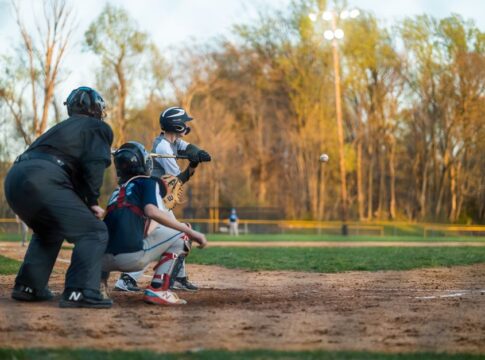
Vocal calls also serve an immediate practical function. When an umpire shouts “Strike three!” with a punching motion, everyone—the batter, catcher, pitcher, base coaches, and 40,000 fans—receives the information simultaneously. No delay. No feedback squeal. No technical malfunction. The human voice, trained and projected correctly, reaches across a baseball diamond with remarkable clarity.
The Authority Behind the Call
An umpire’s strike call isn’t just information—it’s a declaration of authority. The physical act of calling a pitch reinforces the umpire’s role as the game’s ultimate arbiter. Home plate umpires develop distinctive calling styles, from subtle point-and-punch motions to theatrical full-body performances that have become part of their professional identity.
This performative aspect matters more than you might think. Baseball thrives on human judgment. Even with replay review systems now in place, the home plate umpire’s strike zone remains subjective, evaluated in real-time without technological assistance during most of the game. The forceful delivery of a call—voice and gesture combined—communicates confidence and finality. It says: this is the decision, and we’re moving forward.
Microphones would distance the umpire from this direct communication. Instead of a visceral shout that players feel as much as hear, a mic-amplified call would filter through speakers, processed and impersonal. The psychological impact would shift. Players and managers already argue calls passionately; removing the human element of vocal projection might paradoxically increase disputes by making decisions feel more mechanical and therefore more challengeable.
Comparing Communication Systems Across Major Sports
| Sport | Official Communication Method | Reason for Approach |
|---|---|---|
| Baseball | Vocal calls + hand signals, no microphones | Continuous play, traditional soundscape, immediate clarity |
| Football | Wireless microphones for referee announcements | Complex rules require detailed explanations during play stoppages |
| Basketball | Whistle + hand signals, occasional mic for explanations | Fast pace with frequent stoppages; signals sufficient for most calls |
| Soccer | Whistle + hand signals + cards, no microphones | Continuous play across large field; minimal interruption philosophy |
| Tennis | Chair umpire with microphone | Quiet environment requires clear score announcements; play naturally pauses between points |
The Technical Challenges of Microphones in Baseball
Even if tradition weren’t a factor, outfitting umpires with microphones presents surprising practical obstacles. Baseball umpires work in physically demanding positions, particularly the home plate umpire crouching behind the catcher for hours. A microphone system would need to withstand foul balls, collisions at home plate, dust, rain, and extreme heat without failing.
Audio feedback becomes a serious concern in modern ballparks equipped with powerful sound systems. A hot mic near stadium speakers creates loops and squeals that would disrupt play. Engineers could solve this with directional microphones and careful frequency management, but the complexity increases exponentially when you consider that umpires move constantly, changing positions and distances from speakers throughout the game.
Ambient noise in ballparks already reaches 90 to 100 decibels during exciting moments. A microphone would pick up not just the umpire’s voice but crowd noise, player chatter, and field sounds, requiring sophisticated filtering. All this technology to accomplish what a trained voice already does naturally seems like overengineering a solution to a problem that doesn’t exist.
When Umpires Do Use Technology
Baseball hasn’t entirely rejected electronic communication. Umpires wear earpieces to receive information from replay officials in New York during challenged calls. This one-way communication allows the crew chief to hear the replay decision without broadcasting it to the stadium. The official then signals the result using traditional hand gestures and announces it verbally to nearby players and coaches.
This hybrid approach preserves the human interface while leveraging technology where it adds value. The replay system corrects clear errors without fundamentally changing how umpires communicate during live play. It’s a telling example of baseball’s philosophy: adopt helpful innovations while protecting the game’s essential character.
Minor leagues and independent baseball organizations have experimented with automated ball-strike systems, sometimes called “robot umpires.” Even in these trials, a human umpire receives the electronic call via earpiece and then announces it traditionally. The vocal call remains, even when the judgment is automated. This reveals something interesting about what fans and players value—they want the human presence, the ritual of the call, regardless of how the decision is made.
Frequently Asked Questions
Do umpires receive any voice training for making calls?
Professional umpires do receive instruction on proper calling techniques during their training in umpire schools, though it’s not formal voice coaching like actors receive. They learn projection, consistency, and how to develop a clear, authoritative calling style that can be heard across the field without straining their voices over a long season.
Have any professional sports leagues tried and abandoned referee microphones?
While most major leagues that adopted microphones have kept them, some lower-level leagues and international competitions have scaled back microphone use after finding it created more confusion than clarity. Soccer, in particular, has resisted widespread referee microphone adoption despite experiments in various leagues.
Can fans in the stadium actually hear umpire calls clearly?
Fans seated near the field can usually hear emphatic strike and out calls clearly, especially in quieter moments. Those in upper decks or outfield seats rely more on hand signals and scoreboard confirmation. The vocal call is primarily for players, coaches, and nearby spectators, while signals serve everyone.
Do umpires ever lose their voices during long games or doubleheaders?
Experienced umpires develop vocal endurance and technique that prevents voice loss under normal conditions. However, particularly long extra-inning games or doubleheaders in hot, dry conditions can strain even well-trained voices. Umpires stay hydrated and pace their vocal intensity to maintain clarity throughout the game.
The next time you watch a baseball game, pay attention to that split second after a pitch when the umpire’s call cuts through the stadium noise. It’s one of the few remaining moments in professional sports where human voice alone—unfiltered, unamplified, immediate—still carries ultimate authority. That tradition connects today’s game to baseball’s earliest days, when a single voice had to be enough.