
7 Surprising Facts About Hummingbird Flight Mechanics
By Trivia Daily, Animals Desk — Published September 29, 2026
Table of Contents
- Key Takeaways
- The Mechanics Behind Hummingbird Flight
- Energy Demands of Hovering Flight
- Comparing Hummingbird Species Flight Capabilities
- The Seven Most Surprising Facts
- Frequently Asked Questions
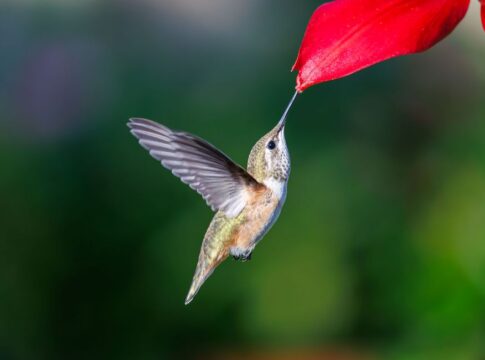
Hummingbirds perform aerial acrobatics that would make even the most advanced helicopters jealous. These tiny creatures can hover in mid-air, fly backward, and even upside down—feats that no other bird species can match. Understanding hummingbird flight mechanics reveals one of nature’s most remarkable engineering achievements, combining power, precision, and physics in a package that weighs less than a nickel.
What makes these diminutive animals such exceptional flyers isn’t just their behavior or habitat preferences—it’s the unique biomechanics hidden beneath their iridescent feathers. From wing rotation patterns that defy conventional bird flight to metabolic rates that push the boundaries of what warm-blooded wildlife can sustain, hummingbirds represent an evolutionary masterpiece.
Key Takeaways
- Hummingbirds are the only birds capable of sustained backward flight, thanks to a unique figure-eight wing pattern
- Their wings beat approximately 50-80 times per second, creating the distinctive humming sound that gives them their name
- Unlike other birds, hummingbirds generate lift on both the upstroke and downstroke of their wingbeats
- These creatures have the highest metabolism of any warm-blooded animal relative to body size
- Hummingbird shoulder joints rotate nearly 180 degrees, far more than any other bird species
- They can instantly shift from forward flight to hovering without any transitional gliding phase
The Mechanics Behind Hummingbird Flight
Most birds fly by flapping their wings up and down, generating lift primarily on the downstroke. Hummingbirds break this rule entirely. Their wings move in a horizontal figure-eight pattern, rotating at the shoulder to create lift in both directions. This bilateral lift generation is what allows them to hover with such stability—their wings are essentially rowing through the air, pushing down on both the forward and backward strokes.
The shoulder joint structure in these birds is radically different from other avian species. While a pigeon or eagle can only move its wings in a limited arc, a hummingbird’s ball-and-socket shoulder joint permits rotation approaching 180 degrees. This extraordinary range of motion transforms their wings into rotating blades rather than simple flapping appendages. The result? Complete three-dimensional control of flight direction and speed.
Energy Demands of Hovering Flight
Hovering is one of the most energy-intensive forms of locomotion in the animal kingdom. Hummingbirds must consume roughly half their body weight in nectar each day to fuel their aerial displays. Their heart rate can exceed 1,200 beats per minute during active flight, and their metabolic rate is approximately 100 times that of an elephant when adjusted for body mass.
To manage these extreme energy demands, hummingbirds enter a state called torpor at night—a hibernation-like condition where their metabolic rate drops by up to 95 percent. Without this nightly energy-saving mode, they would starve to death before morning. This dramatic metabolic flexibility represents one of nature’s most effective solutions to the challenge of powering impossibly energy-hungry flight.
Comparing Hummingbird Species Flight Capabilities
| Species | Wingbeat Frequency | Maximum Speed | Special Capability |
|---|---|---|---|
| Ruby-throated Hummingbird | ~53 beats/second | 30 mph | Longest migration route |
| Anna’s Hummingbird | ~40 beats/second | 61 mph (dive) | Fastest dive relative to body length |
| Giant Hummingbird | ~15 beats/second | 25 mph | Largest species, slower wingbeats |
| Bee Hummingbird | ~80 beats/second | 25 mph | Smallest bird in the world |
The Seven Most Surprising Facts
1. Wings Generate Lift Like Insect Wings, Not Bird Wings
Hummingbirds are the only birds whose flight mechanics more closely resemble those of insects than other avian species. Their wings are stiff, rigid structures that don’t fold at the wrist like typical bird wings. Instead, they rotate at the shoulder in a motion that mirrors dragonfly or bee flight patterns. This convergent evolution between hummingbirds and insects occurred independently, demonstrating that hovering flight demands similar biomechanical solutions regardless of the creature’s evolutionary lineage.
2. They Can Fly Backward Faster Than Some Birds Fly Forward
While most birds struggle to move backward at all—and none can sustain it—hummingbirds reverse direction with remarkable speed and control. By adjusting the angle and rotation of their wings mid-stroke, they redirect thrust instantly. Some species can fly backward at speeds exceeding 10 miles per hour, which is faster than many songbirds can fly forward. This ability proves essential when feeding from tubular flowers, allowing them to insert their beaks, drink, and retreat without turning around.
3. Their Wings Beat in a Perfect Figure-Eight Pattern
High-speed photography reveals that hummingbird wings trace a sideways figure-eight through the air during hovering. The wing tilts nearly vertical on the forward stroke, then rotates approximately 180 degrees to tilt vertical in the opposite direction on the backstroke. This rotation happens so quickly that the human eye perceives only a blur. The figure-eight pattern creates two vortexes of air per wingbeat cycle, generating continuous lift without the gaps that occur in conventional flapping flight.
4. Their Flight Muscles Comprise Nearly 30 Percent of Body Weight
The pectoral muscles that power hummingbird wings represent an extraordinary proportion of their total body mass—roughly 25-30 percent. For comparison, these flight muscles account for only about 15 percent of body weight in pigeons. This massive muscle investment reflects the enormous power requirements of hovering flight. The muscle fibers themselves are packed with mitochondria, the cellular powerhouses that convert sugar into mechanical energy at astonishing rates.
5. They Experience G-Forces That Would Incapacitate Human Pilots
During courtship displays, male Anna’s hummingbirds perform spectacular dive maneuvers, pulling out of steep descents at forces exceeding 9 Gs—more than fighter pilots experience during aerial combat maneuvers. At the bottom of these dives, blood pressure in their heads would theoretically spike to levels that would cause humans to black out instantly. Yet hummingbirds execute these displays repeatedly without apparent ill effects, suggesting specialized cardiovascular adaptations that prevent brain damage from extreme acceleration.
6. Wing Shape Changes Dramatically Between Species and Flight Modes
Not all hummingbird wings are created equal. Species that specialize in hovering tend to have shorter, broader wings with higher wingbeat frequencies. Migratory species develop longer, more pointed wings that improve efficiency during sustained forward flight. Individual birds can even adjust wing stiffness and curvature through subtle muscle contractions, fine-tuning their aerodynamic properties for different flight challenges throughout the day.
7. They Can Sense and Correct for Wind Turbulence in Milliseconds
Maintaining stable hovering position requires constant micro-adjustments to counter air currents and turbulence. Hummingbirds process visual and proprioceptive feedback with extraordinary speed, making corrective wing adjustments within 10 milliseconds of detecting disturbance. This reaction time surpasses that of most animals and approaches the physical limits imposed by nerve conduction velocity. Their brains have specialized regions dedicated to processing the rapid sensory input needed for precision flight control.
Frequently Asked Questions
Why can’t other birds fly backward like hummingbirds?
Most birds lack the specialized shoulder joint that allows 180-degree wing rotation. Their wing structure generates lift primarily on the downstroke, making sustained backward flight biomechanically impossible. Hummingbirds evolved unique skeletal and muscular adaptations specifically for omnidirectional flight.
How do hummingbirds hover in place without drifting?
They use visual feedback from their surroundings to detect even tiny positional changes, then make instant wing adjustments to compensate. Their figure-eight wing pattern creates balanced thrust in all directions, while their rapid sensory processing allows real-time stabilization against wind and turbulence.
Do hummingbirds ever stop flapping their wings while flying?
Unlike most birds, hummingbirds rarely glide. Their wing structure is optimized for powered flight, not gliding, so stopping their wingbeats would cause them to drop immediately. They must continuously flap to remain airborne, even during forward flight.
What is the smallest hummingbird species and how does size affect flight?
The bee hummingbird of Cuba is the world’s smallest bird, weighing around 2 grams. Smaller species require faster wingbeat frequencies to generate sufficient lift—the bee hummingbird beats its wings approximately 80 times per second, while larger hummingbird species may beat their wings only 15-20 times per second.
The next time you spot one of these aerial marvels hovering at a flower, remember you’re witnessing flight mechanics that took millions of years to perfect. Every wingbeat represents a solution to aerodynamic challenges that human engineers are still working to fully understand and replicate in miniature aircraft designs.