
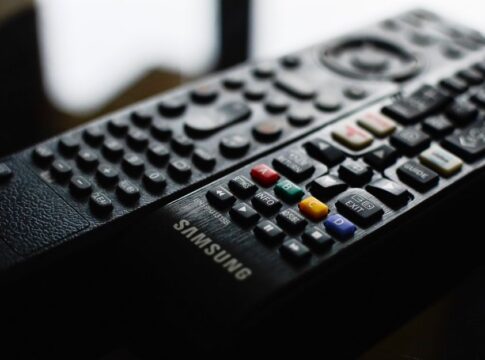
Why TV Remote Controls Use Infrared Light Instead of Radio
By Trivia Daily, Staff Writer — Published September 30, 2026
Table of Contents
- Key Takeaways
- The Physics Behind Remote Controls Infrared Technology
- Why Radio Waves Lost the Remote Control Battle
- The Evolution From Ultrasonic to Infrared
- Comparing Infrared and Radio Frequency Remote Controls
- The Surprising Limitations That Became Features
- Frequently Asked Questions
Every time you reach for your TV remote, you’re wielding a device that sends invisible pulses of light across your living room. It’s a curious fact that most remote controls infrared technology has dominated home entertainment for decades, despite radio waves being the backbone of wireless communication everywhere else. The reason isn’t just about cost or convenience—it’s a fascinating interplay of physics, practicality, and the peculiar demands of controlling electronics in your home.
The choice between infrared and radio frequencies represents one of those everyday engineering decisions that shapes how we interact with technology. While smartphones, Wi-Fi routers, and garage door openers all rely on radio waves to communicate, your humble TV clicker still blinks away with infrared pulses. This isn’t an oversight or outdated design—it’s actually a deliberate choice with surprising advantages.
Key Takeaways
- Infrared remote controls use light wavelengths just beyond the visible spectrum, typically around 940 nanometers, invisible to human eyes but detectable by sensors.
- Infrared signals don’t pass through walls, preventing your remote from accidentally controlling your neighbor’s TV—a built-in feature that radio-based systems would struggle to replicate.
- The first wireless TV remote, Zenith’s “Space Command” from 1956, actually used ultrasonic sound, not infrared—technology didn’t shift to infrared until the late 1970s.
- Infrared remotes are significantly cheaper to manufacture than radio frequency alternatives, with simpler circuitry and no need for complex encoding to prevent interference.
- Most infrared remote controls consume minimal power, allowing batteries to last months or even years under normal use.
- Line-of-sight limitations, often seen as a drawback, actually prevent signal interference between multiple devices in densely packed homes.
The Physics Behind Remote Controls Infrared Technology
Infrared light occupies a special place in the electromagnetic spectrum, sitting just below visible red light in terms of wavelength. Remote controls typically emit infrared at wavelengths around 940 nanometers—completely invisible to human eyes but easily detected by specialized sensors. When you press a button, a light-emitting diode (LED) in the remote flashes on and off in rapid patterns, encoding your command as a series of pulses.
These pulses travel at the speed of light—roughly 186,000 miles per second—but only in straight lines. Unlike radio waves, which can diffract around obstacles and penetrate walls, infrared light behaves much like visible light. It bounces off mirrors, gets absorbed by dark surfaces, and stops dead at solid barriers. This line-of-sight requirement might seem like a limitation, but it’s actually one of infrared’s greatest strengths for home electronics.
The encoding scheme varies by manufacturer, but most use a standardized protocol. A typical command might consist of a start signal, followed by a specific pattern of pulses representing a device code and a function code, all transmitted in less than a tenth of a second. The receiving sensor detects these pulses, decodes the pattern, and executes the command.
Why Radio Waves Lost the Remote Control Battle
Radio frequency (RF) remote controls do exist—you’ll find them in car key fobs, some high-end home theater systems, and gaming consoles. They offer genuine advantages: no need to point directly at the device, signals that work through walls, and longer range. So why didn’t radio win?
The answer comes down to interference and cost. Radio waves require careful frequency management to prevent devices from interfering with each other. Imagine living in an apartment building where dozens of TVs, remotes, garage door openers, and wireless devices all compete for the same radio spectrum. Without sophisticated encoding and decoding—which adds cost and complexity—your remote might change your neighbor’s channel instead of yours.
Infrared signals, by contrast, are naturally confined to a single room. They can’t pass through walls or travel around corners without a clear reflection path. This physical limitation becomes a feature rather than a bug. Each room effectively becomes its own isolated communication zone, eliminating cross-talk between devices.
Manufacturing costs tell another part of the story. An infrared LED and basic circuitry cost pennies to produce. Radio transmitters require oscillators, antennas, and more complex components. When you’re making millions of remotes, those pennies add up to substantial savings that get passed to consumers.
The Evolution From Ultrasonic to Infrared
The earliest wireless remote controls didn’t use light or radio—they used sound. Zenith’s Space Command remote from 1956 contained tiny hammers that struck aluminum rods, creating ultrasonic tones beyond human hearing. Each button produced a different frequency, which the TV detected and decoded. The system worked without batteries, powered purely by the mechanical force of pressing buttons.
But ultrasonic remotes had problems. Jingling keys could trigger channel changes. The mechanical components wore out. And as TVs gained more functions, the limited number of distinct tones became constraining. When infrared LEDs became affordable in the late 1970s, manufacturers quickly switched. Infrared offered unlimited encoding possibilities, solid-state reliability, and immunity to acoustic interference.
The transition happened remarkably fast. By the mid-1980s, infrared had become the universal standard for TV remotes, a position it maintains today despite the rise of smartphone apps and voice control.
Comparing Infrared and Radio Frequency Remote Controls
| Feature | Infrared (IR) | Radio Frequency (RF) |
|---|---|---|
| Range | Approximately 30 feet with line of sight | Up to 100+ feet, works through walls |
| Line of Sight Required | Yes, must point at device | No, works from any direction |
| Manufacturing Cost | Very low (under $1 for basic models) | Higher due to complex circuitry |
| Interference Risk | Minimal—signals don’t travel between rooms | Higher—requires encoding to prevent cross-talk |
| Battery Life | Months to years | Weeks to months |
| Common Uses | TVs, air conditioners, basic electronics | Car keys, gaming consoles, premium AV equipment |
The Surprising Limitations That Became Features
You might think requiring line of sight is purely a disadvantage, but consider the alternative. Radio-based remotes in multi-unit buildings would need unique identifiers for every device to prevent your commands from affecting neighbors’ equipment. This requires pairing processes, more memory in both remote and receiver, and potential security vulnerabilities.
Infrared’s inability to penetrate walls creates natural security. Your TV commands stay in your room. There’s no pairing process, no setup, no configuration. Pop in batteries and start clicking. This simplicity has kept infrared relevant even as wireless technology has advanced dramatically in other domains.
Bright sunlight and certain types of fluorescent lighting can interfere with infrared signals—a genuine drawback. But for most users in most situations, infrared works reliably enough that the cost savings and simplicity outweigh occasional hiccups.
Frequently Asked Questions
Can you see infrared light from a remote control?
Human eyes cannot see infrared light directly, but most smartphone cameras can detect it. Point your remote at your phone’s camera and press a button—you’ll see the LED flash on your screen, even though it’s invisible in person.
Why do some remotes work better than others at bouncing signals off walls?
Infrared light reflects off light-colored, smooth surfaces much like visible light. Remotes with more powerful LEDs can bounce signals effectively off ceilings and walls, while weaker ones require more direct aiming. Dark, textured surfaces absorb infrared rather than reflecting it.
Do universal remotes use the same infrared technology as original remotes?
Yes, universal remotes use standard infrared LEDs and store multiple code libraries for different manufacturers. They work by learning or pre-programming the specific pulse patterns each device expects, then reproducing those patterns when you press buttons.
Will infrared remotes eventually be replaced by radio or Bluetooth?
While smartphones and voice assistants offer alternative control methods, infrared remotes remain popular due to their simplicity, low cost, and reliability. Many new TVs include both infrared sensors and Wi-Fi or Bluetooth connectivity, giving users options rather than forcing a single technology.
Next time you pick up your remote, take a moment to appreciate the invisible light show happening in your living room. That simple plastic device represents a careful engineering compromise—choosing containment over range, simplicity over sophistication, and proven technology over newer alternatives. Sometimes the most interesting aspect of everyday objects is discovering why they work the way they do, rather than how they might work differently.