
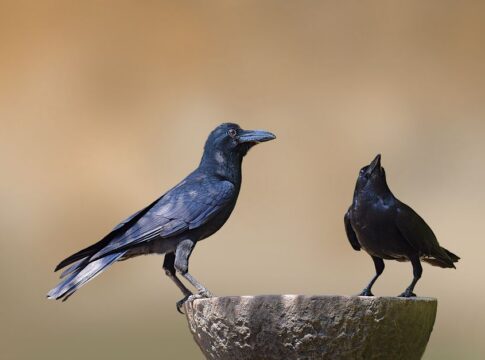
Why Crows Can Remember Human Faces for Years
By Trivia Daily, Animals Desk — Published August 31, 2026
Table of Contents
- Key Takeaways
- How Crows Remember Human Faces and Why It Matters
- The Science Behind Crow Intelligence and Memory
- Comparing Crow Memory to Other Wildlife Species
- How Crows Use Memory in Their Daily Behavior
- What Crow Memory Reveals About Animal Cognition
- Frequently Asked Questions
If you’ve ever felt like a crow was holding a grudge, you’re probably right. These remarkably intelligent birds possess an extraordinary ability that sets them apart in the animal kingdom: crows remember human faces for years, sometimes even decades. Scientists have documented how these creatures can distinguish between individual people, recall specific encounters, and pass warnings about dangerous humans to other members of their flock. This isn’t just impressive memory—it’s a sophisticated survival skill that reveals the depth of crow intelligence.
The research into how crows remember human behavior has transformed our understanding of animal cognition. These birds don’t simply react to immediate threats. They learn, categorize, and share information about people who have wronged them or helped them, creating a complex social network of knowledge that spans generations.
Key Takeaways
- Crows can recognize and remember individual human faces for at least five years, with some evidence suggesting memories may last much longer.
- These birds can distinguish between people who have threatened them and those who have been kind, responding differently to each individual.
- Crows share information about dangerous humans with other crows who have never encountered that person, creating a collective memory within their habitat.
- The facial recognition abilities of crows rival those of primates, demonstrating remarkable cognitive sophistication in a bird species.
- Crows remember not just faces but also specific behaviors and contexts, allowing them to predict human actions based on past encounters.
- This memory system serves as a crucial survival mechanism in nature, helping crows avoid threats and identify sources of food or safety.
How Crows Remember Human Faces and Why It Matters
Researchers at the University of Washington conducted groundbreaking experiments that revealed the extent of crow facial recognition. Scientists wore distinctive masks while capturing and banding wild crows—a mildly threatening but harmless procedure. The results were striking. Crows who had been captured scolded and dive-bombed anyone wearing the “dangerous” mask, even years after the initial encounter. Meanwhile, people wearing neutral masks walked by unmolested.
The recognition isn’t limited to the birds who experienced the original event. Crows who witnessed the capture from nearby trees also learned to recognize and scold the masked person. Even more remarkably, young crows who weren’t born when the captures occurred learned to identify the threatening mask from older birds. This cultural transmission of information demonstrates a level of social learning previously associated mainly with mammals.
The neural mechanisms behind this ability are equally fascinating. Crows possess a brain region analogous to the mammalian cerebral cortex, despite having a fundamentally different brain structure. This region allows them to process complex visual information and form lasting memories. Their brain-to-body ratio is comparable to that of great apes, providing the computational power necessary for sophisticated cognitive tasks.
The Science Behind Crow Intelligence and Memory
What makes crows remember human individuals so effectively? The answer lies in their remarkable neural architecture and evolutionary pressures. Corvids—the family of birds that includes crows, ravens, jays, and magpies—have evolved in environments where remembering specific threats and opportunities provides significant survival advantages.
Crows don’t just recognize faces in isolation. They associate facial features with specific behaviors, locations, and outcomes. A crow remembers not only what you look like but also what you did, where you did it, and whether you posed a threat or offered food. This contextual memory allows them to make predictions about future encounters, a cognitive feat that requires advanced processing.
The hippocampus and nidopallium caudolaterale (NCL) in crow brains play crucial roles in memory formation and facial recognition. The NCL functions similarly to the prefrontal cortex in mammals, supporting working memory and executive function. This neural equipment enables crows to perform tasks that challenge even highly intelligent animals, from tool use to problem-solving to long-term planning.
Comparing Crow Memory to Other Wildlife Species
| Species | Facial Recognition Ability | Memory Duration | Social Learning |
|---|---|---|---|
| Crows | Recognize individual humans | 5+ years confirmed | Share information across generations |
| Elephants | Recognize individuals by sight and smell | Decades | Strong matriarchal knowledge transfer |
| Dolphins | Recognize signature whistles | 20+ years | Cultural transmission documented |
| Chimpanzees | Recognize faces and expressions | Years to decades | Complex social learning |
| Dogs | Recognize familiar humans | Years | Limited social transmission |
How Crows Use Memory in Their Daily Behavior
In urban and rural habitats alike, crows leverage their memory to navigate complex relationships with humans. They remember which neighborhoods have dog owners who leave food out, which garbage cans offer the best pickings, and which people to avoid. Some crows have been observed bringing small gifts to humans who feed them regularly—a behavior that suggests not just memory but also reciprocity.
The warning calls crows emit when they spot a dangerous person serve multiple purposes. These vocalizations alert other crows to potential threats and reinforce social bonds within the group. Young crows learn the significance of these calls and the associated faces, building their own mental database of trustworthy and threatening individuals.
Territorial behavior also relies heavily on memory. Crows defend their breeding territories against intruders, but they must distinguish between genuine threats and harmless passersby. Their ability to remember which humans routinely walk through their territory without causing harm prevents unnecessary energy expenditure on false alarms.
What Crow Memory Reveals About Animal Cognition
The facial recognition abilities of crows challenge traditional assumptions about animal intelligence. For decades, scientists believed that only large-brained mammals possessed the cognitive machinery for such complex tasks. Crows prove that brain size matters less than brain organization and neural density.
This discovery has implications for how we understand consciousness and cognition in nature. If birds with vastly different brain structures can achieve cognitive feats comparable to primates, then intelligence may have evolved through multiple independent pathways. The convergent evolution of similar capabilities in distantly related creatures suggests that certain environmental pressures consistently favor the development of advanced memory and recognition systems.
Researchers now recognize that many bird species possess cognitive abilities that were once considered uniquely mammalian. Parrots solve complex puzzles, magpies recognize themselves in mirrors, and jays plan for future needs. The corvid family stands out even among these impressive performers, with crows demonstrating perhaps the most sophisticated integration of memory, social learning, and behavioral flexibility.
Frequently Asked Questions
How long can crows actually remember a human face?
Scientific studies have confirmed that crows can remember individual human faces for at least five years, with anecdotal evidence suggesting their memories may last much longer, potentially for the bird’s entire lifetime. The strength and duration of the memory appears to depend on the significance of the interaction.
Can crows tell the difference between two similar-looking people?
Yes, crows can distinguish between individuals who look similar to humans, focusing on subtle facial features, body language, and gait. Their visual processing systems are highly sophisticated, allowing them to pick up on details that differentiate one person from another even when both wear similar clothing.
Do all crow species have the same memory abilities?
While most research has focused on American crows and carrion crows, evidence suggests that all corvid species possess advanced cognitive abilities, though the extent may vary. Ravens, close relatives of crows, demonstrate comparable or even superior problem-solving and memory skills in some contexts.
Will a crow remember someone who helped it?
Absolutely. Crows remember positive interactions just as well as negative ones, and they often respond to kindness with curiosity or even gift-giving behavior. Some individuals who regularly feed crows report that the birds bring them shiny objects, buttons, or other small items as apparent tokens of appreciation.
The next time you encounter a crow, remember that it might very well be remembering you. These remarkable birds navigate our shared world with a sophistication that demands respect and wonder. In studying how crows remember human faces, we’ve discovered not just an interesting animal behavior but a window into the diverse forms intelligence can take across the tree of life.