
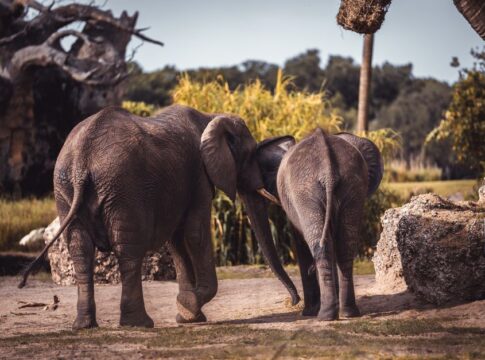
Why Elephants Are the Only Mammals That Cannot Jump
By Trivia Daily, Animals Desk — Published August 10, 2026
Table of Contents
- Key Takeaways
- Why Elephants Mammals Cannot Jump: The Anatomy Behind the Limitation
- How Elephants Compare to Other Large Animals
- What Elephants Do Instead: Remarkable Adaptations
- The Evolution of Elephant Locomotion
- Common Myths About Elephant Movement
- Frequently Asked Questions
Among all the remarkable creatures in the animal kingdom, elephants stand apart for a peculiar limitation: they are the only mammals on Earth that cannot jump. While tiny mice can leap several times their body length and even massive hippos can briefly become airborne, these gentle giants remain firmly grounded throughout their lives. This unique trait among elephants mammals cannot replicate has everything to do with their extraordinary anatomy and the physics of moving several tons of body weight.
The inability to jump doesn’t diminish these magnificent animals in the slightest. Elephants have evolved to thrive in their habitat without ever needing to leave the ground, using their intelligence and specialized behavior to navigate obstacles that would require other wildlife species to jump.
Key Takeaways
- Elephants are the only mammals physically incapable of jumping, with all four feet never simultaneously leaving the ground.
- An adult elephant’s skeletal structure and body mass—up to 13,000 pounds—make jumping biomechanically impossible.
- Elephant leg bones are structured vertically to support immense weight, lacking the spring-like tendons found in jumping animals.
- Despite this limitation, elephants can move surprisingly fast, reaching speeds of up to 25 miles per hour.
- Other large animals like hippos and rhinos can briefly achieve airborne moments, making elephants unique among heavyweight creatures.
- This trait has no negative impact on elephant survival in nature, as their size and intelligence provide ample protection.
Why Elephants Mammals Cannot Jump: The Anatomy Behind the Limitation
The reason elephants cannot jump lies in their remarkable skeletal architecture. Unlike most mammals, elephants have leg bones arranged almost vertically, stacked like pillars beneath their massive bodies. This columnar structure excels at supporting weight—essential when you’re carrying up to six tons—but it sacrifices the flexibility needed for jumping.
Jumping requires specialized anatomy. Animals that jump well possess strong, elastic tendons that store and release energy like springs. Think of a kangaroo’s powerful Achilles tendon or the spring-loaded hind legs of a rabbit. Elephants lack these elastic structures. Their legs are built for stability and endurance, not explosive power. The bones are thick and heavy, with relatively weak leg muscles compared to their total body mass. While an elephant’s muscles are certainly powerful in absolute terms, they represent a much smaller percentage of body weight than in animals built for jumping.
The sheer physics present another insurmountable challenge. To jump, an animal must generate enough upward force to overcome gravity and lift its entire mass off the ground simultaneously. For a creature weighing several tons, this would require leg muscles exponentially more powerful than what elephants possess. The energy expenditure would be astronomical, and the impact upon landing could cause catastrophic skeletal damage.
How Elephants Compare to Other Large Animals
What makes elephants truly unique is that other heavyweight animals can manage brief airborne moments, even if they’re not graceful jumpers. This comparison reveals just how specialized elephant anatomy has become.
| Animal | Adult Weight | Can Jump? | Notes |
|---|---|---|---|
| African Elephant | 8,000–13,000 lbs | No | All four feet never leave ground simultaneously |
| Hippopotamus | 3,000–4,000 lbs | Yes | Can gallop with brief airborne phases |
| White Rhinoceros | 4,000–6,000 lbs | Yes | Can achieve airborne moment at full gallop |
| Giraffe | 1,800–2,600 lbs | Yes | Can gallop with all feet off ground |
What Elephants Do Instead: Remarkable Adaptations
The inability to jump has never held elephants back in their natural habitat. These intelligent creatures have developed alternative strategies that serve them remarkably well in the wild. When faced with obstacles, elephants simply walk around them or use their incredible strength to move them aside. Their trunks—containing roughly 40,000 muscles—can lift objects weighing up to 600 pounds, making it easy to clear paths.
Elephants are also surprisingly agile for their size. They can kneel down and stand back up with relative ease, navigate steep terrain, and even swim powerfully across rivers and lakes. In water, elephants become buoyant and graceful, using their trunks as snorkels. They’ve been observed swimming for hours covering significant distances between islands.
Speed is another area where elephants compensate. While they cannot jump, they can move at impressive velocities. A charging elephant can reach speeds of 25 miles per hour—fast enough to outrun most humans. They accomplish this through a unique gait that’s technically a fast walk rather than a run, with at least two feet always maintaining ground contact.
The Evolution of Elephant Locomotion
Understanding why elephants evolved this way requires looking at their ecological niche. Elephants are mega-herbivores that spend up to 18 hours daily foraging for the hundreds of pounds of vegetation they need. Their survival strategy centers on size, strength, and intelligence rather than speed or jumping ability. In the African savanna and Asian forest habitat where elephants live, being large provides protection from predators. Adult elephants have virtually no natural enemies besides humans.
The evolutionary trade-off makes perfect sense. Elephants sacrificed jumping ability to gain skeletal structures capable of supporting immense weight over long distances. Their ancestors gradually increased in size over millions of years, and as they grew larger, the biomechanics of jumping became increasingly unfavorable. Eventually, the ability disappeared entirely.
This specialization allowed elephants to access food sources other animals couldn’t reach. They can push over entire trees to access foliage, dig for water during droughts, and migrate vast distances across varied terrain. None of these survival behaviors require jumping.
Common Myths About Elephant Movement
Several misconceptions persist about elephant locomotion and behavior. One widespread myth suggests that elephants are afraid of mice, supposedly because they might run up their trunks. Scientific observations have debunked this notion—elephants show no particular fear of small rodents, and their inability to jump has nothing to do with avoiding tiny creatures.
Another common belief holds that elephants cannot run. While technically true in the biomechanical sense—running requires an airborne phase—elephants can move remarkably quickly using their specialized fast walk. The distinction matters to scientists studying animal locomotion but makes little practical difference in nature.
Some people assume that baby elephants might be able to jump. Young calves are certainly more nimble than adults, but even newborns weighing around 200 pounds lack the anatomical structures necessary for jumping. From birth, elephants are built to stay grounded.
Frequently Asked Questions
Can any elephants jump at all, even a little bit?
No elephants can jump. Neither African nor Asian elephant species can lift all four feet off the ground simultaneously at any point in their lives, from birth through adulthood. This limitation is absolute across all three recognized species.
Are there any other animals that cannot jump?
Among mammals, elephants are unique in their complete inability to jump. However, some other animals like sloths and hippos rarely jump despite being technically capable of brief airborne moments. Many reptiles and amphibians also cannot jump, but elephants remain the only mammals with this distinction.
Could ancient elephant relatives jump?
Early elephant ancestors were much smaller and likely had greater agility, but whether they could truly jump remains unknown. As the elephant lineage evolved toward larger body sizes over millions of years, jumping ability would have been lost relatively early in their evolutionary history.
Do elephants need to jump to survive in the wild?
Not at all. Elephants thrive in their natural habitat without jumping. Their size, strength, intelligence, and social behavior provide all the advantages they need for survival, making jumping ability unnecessary for their ecological success.
The elephant’s inability to jump stands as a fascinating example of evolutionary specialization. These remarkable animals traded one ability for others far more valuable to their survival—immense strength, extraordinary intelligence, and the capacity to reshape their environment. Sometimes in nature, what you cannot do matters far less than what you can.