
⏱️ 10 min read
One of history’s most celebrated artistic achievements was created by a man who despised every moment of the process. Michelangelo Buonarroti, the Renaissance master who gave the world the breathtaking frescoes of the Sistine Chapel ceiling, considered himself a sculptor first and foremost—and he actively resented being forced to spend four grueling years flat on his back painting biblical scenes overhead.
Quick Facts
- Michelangelo painted the Sistine Chapel ceiling from 1508 to 1512, covering approximately 12,000 square feet with over 300 figures.
- He wrote a sonnet complaining about the physical pain of painting the ceiling, describing his beard pointing skyward and paint dripping onto his face.
- Pope Julius II essentially forced the reluctant sculptor to accept the commission, despite Michelangelo’s protests that he was not a painter.
- The artist worked on scaffolding 60 feet above the chapel floor, often in uncomfortable positions that left him with lasting neck and back problems.
- Michelangelo dismissed painting as an inferior art form compared to sculpture, calling it “women’s work” in his correspondence.
The Sculptor Who Didn’t Want to Paint
Michelangelo’s identity was inseparable from marble and chisel. By 1505, he had already completed his magnificent David statue in Florence and was deeply invested in designing an elaborate tomb for Pope Julius II—a massive sculptural project that would have included more than 40 life-sized figures. When Julius II abruptly canceled the tomb commission and instead demanded that Michelangelo paint the Sistine Chapel ceiling in 1508, the artist was devastated. He had spent months in the marble quarries of Carrara selecting the perfect stones for the tomb, only to have the project indefinitely postponed.
In letters to his family and friends, Michelangelo complained bitterly about being reassigned. He suspected that rival artists, particularly the painter Bramante, had convinced the Pope to give him the ceiling commission precisely because they believed he would fail at large-scale fresco work. Michelangelo had virtually no experience with the demanding fresco technique, which required applying pigment to wet plaster that would dry within hours. One mistake meant chipping away the entire section and starting over.
His protests to Pope Julius II were direct and persistent. Michelangelo argued that painting was not his profession and suggested that Raphael, the renowned painter, would be better suited for the job. The Pope refused to budge. Julius II was known for his iron will—contemporaries called him “the Warrior Pope”—and once he decided Michelangelo would paint the ceiling, no amount of artistic objection would change his mind.
The Physical Agony of the Work
The working conditions Michelangelo endured would break most people. Contrary to popular belief, he did not paint lying on his back. Instead, he designed a curved scaffolding system that allowed him to stand, but required him to arch his spine backward at severe angles to reach the ceiling sections. He stood for hours each day with his head tilted back, arms raised overhead, applying paint to the curved vault 60 feet above the chapel floor.
The physical toll was immediate and brutal. Michelangelo documented his suffering in a satirical sonnet written to his friend Giovanni da Pistoia around 1509. In vivid detail, he described how his stomach was thrust toward his chin, his beard pointed skyward, and his face became “a fine floor for droppings” as paint continuously dripped onto him. He wrote of developing a goiter-like swelling in his throat from the constant backward position and complained that his spine had become curved “like a Syrian bow.”
The paint drops weren’t merely annoying—they were toxic. Renaissance pigments contained heavy metals including lead, mercury, and arsenic. Working in the enclosed space of the chapel, Michelangelo inhaled paint dust and absorbed chemicals through his skin day after day. Modern medical analysis suggests he likely suffered from chronic lead poisoning, which would have caused headaches, joint pain, and possibly contributed to his famously irritable temperament during this period.
His eyesight deteriorated significantly during the four years of work. The constant upward gaze and poor lighting conditions strained his vision so severely that for months after completing the ceiling in 1512, he could only read letters by holding them above his head. He reported this problem in correspondence, noting that his eyes refused to focus normally on anything at standard reading level.
Artistic Conflicts and Creative Control
Beyond physical misery, Michelangelo fought constant battles over artistic decisions. Pope Julius II was an impatient patron who regularly climbed the scaffolding to check progress and demand faster completion. According to Giorgio Vasari’s contemporary biography, during one inspection the Pope asked when Michelangelo would finish. The artist replied, “When I can.” Enraged, Julius struck him with his walking stick and repeated the question. Michelangelo’s answer remained unchanged.
The original commission was far more modest than the masterpiece we see today. Julius II initially wanted Michelangelo to paint the twelve apostles in the ceiling’s triangular sections, with decorative patterns filling the rest. Michelangelo found this design “a poor thing” and successfully argued for a much more ambitious scheme depicting the Creation, the Fall of Man, and Noah’s story—essentially a visual narrative of humanity before the coming of Christ. This expansion transformed a straightforward decorative project into a theological and artistic statement of unprecedented complexity.
He worked largely alone, rejecting assistants and keeping the chapel locked during painting sessions. When he did initially hire experienced fresco painters from Florence to help with the project’s start in 1508, he found their work inadequate within weeks. Michelangelo actually scraped off their contributions and sent them home, insisting on doing virtually all the painting himself. Only a few assistants remained to grind pigments and prepare plaster—the master applied nearly every brushstroke personally across the 12,000 square feet of ceiling.
The Genius Born from Resentment
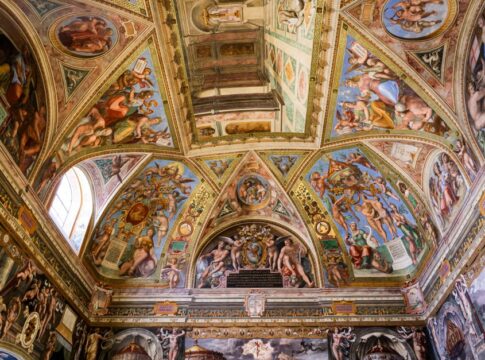
The irony of Michelangelo hating this painting commission is that it produced what many consider the greatest artwork of Western civilization. The ceiling contains nine central panels depicting stories from Genesis, surrounded by prophets, sibyls, and the ancestors of Christ—a total of more than 300 figures, each anatomically precise and emotionally distinctive. The Creation of Adam alone, with God’s finger nearly touching Adam’s, has become perhaps the most recognized image in art history.
His sculptural training actually enhanced the painted figures rather than limiting them. Each body on the ceiling displays the three-dimensional anatomical knowledge Michelangelo gained from years of studying cadavers and carving marble. The prophet Jonah appears to thrust forward from the curved ceiling surface through masterful foreshortening. The ignudi—twenty athletic male nudes positioned around the central panels—twist and turn with sculptural solidity that painters of the era struggled to achieve.
The color palette Michelangelo employed was revolutionary. Where earlier Renaissance frescoes used muted earth tones, the Sistine ceiling exploded with vibrant purples, greens, oranges, and blues. Recent restoration work completed between 1980 and 1994 revealed these brilliant original colors, shocking art historians who had assumed centuries of candle smoke had merely darkened more subdued tones. Michelangelo had intentionally chosen this bold chromatic intensity, though he received no formal training in color theory for fresco work.
The Lasting Impact on Michelangelo’s Career
Completing the Sistine Chapel ceiling in October 1512 didn’t end Michelangelo’s complicated relationship with the space. Twenty-three years later, in 1535, Pope Paul III commissioned him to paint The Last Judgment on the chapel’s altar wall—another project Michelangelo initially resisted. By then in his sixties, he spent another seven years painting the massive 45-by-40-foot fresco depicting Christ’s second coming and the final judgment of souls.
The physical damage from the ceiling work never fully healed. Michelangelo’s letters from later life frequently mention chronic back pain, neck stiffness, and vision problems he directly attributed to those four years on the scaffolding. In a 1542 letter written when he was 67, he described himself as “old and weary” and referenced the “great strain” the ceiling had placed on his body three decades earlier.
Despite creating one of humanity’s supreme artistic achievements, Michelangelo rarely spoke positively about the experience. He continued to identify primarily as a sculptor throughout his 88-year life. His tomb designs, his Moses statue, his Pietà sculptures—these were the works he discussed with pride in correspondence. The Sistine Chapel ceiling, which had consumed four years of his prime creative period and left him physically damaged, remained something he had endured rather than enjoyed.
The ceiling did establish his reputation as a universal genius capable of mastering any medium, however unwillingly. After 1512, no one could claim Michelangelo was merely a talented sculptor. He had proven himself the equal of Leonardo da Vinci and Raphael in painting, even though he had achieved this through gritted teeth and constant complaint. This reluctant masterpiece elevated him to a status few artists in history have achieved—that of someone who could work in any medium and create works of transcendent genius.
Frequently Asked Questions
Did Michelangelo paint the Sistine Chapel ceiling while lying on his back?
No, Michelangelo designed scaffolding that allowed him to stand while painting, though he had to arch his back severely and hold his arms overhead for hours at a time. This widespread misconception may stem from the 1965 film “The Agony and the Ecstasy,” which depicted him working horizontally.
How long did it take Michelangelo to complete the Sistine Chapel ceiling?
Michelangelo painted the Sistine Chapel ceiling from May 1508 to October 1512, a total of approximately four years. He worked on the project with minimal assistance, personally painting the vast majority of the 12,000 square feet of frescoed surface containing over 300 figures.
Why did Michelangelo agree to paint the ceiling if he didn’t want to?
Pope Julius II essentially forced Michelangelo to accept the commission despite the artist’s repeated protests. Refusing a papal commission in 1508 was not a realistic option, as the Pope wielded immense political and financial power that could destroy an artist’s career.
What permanent damage did painting the ceiling cause Michelangelo?
Michelangelo suffered lasting vision problems, chronic back and neck pain, and possible lead poisoning from the toxic pigments. He reported being unable to read at normal angles for months after finishing and referenced the physical toll in letters for the rest of his life.
Key Takeaways
- Michelangelo considered himself a sculptor, not a painter, and deeply resented being forced by Pope Julius II to paint the Sistine Chapel ceiling from 1508 to 1512.
- The physical conditions of the work caused severe and permanent damage to his back, neck, and eyesight, which he documented in letters and poetry describing paint dripping on his face and his spine curving unnaturally.
- Despite his hatred of the project, Michelangelo’s sculptural expertise and revolutionary approach to color created what many consider Western civilization’s greatest artistic achievement, containing over 300 biblically-inspired figures.
- The artist worked largely alone after dismissing assistants, personally painting nearly all 12,000 square feet while standing on scaffolding 60 feet above the chapel floor in uncomfortable positions for four years.