
⏱️ 9 min read
When a great white shark cruises through the ocean at speeds up to 25 miles per hour, it relies on a skeleton unlike any other vertebrate on Earth. These apex predators have patrolled our oceans for more than 400 million years—long before the first dinosaurs appeared—yet their bodies contain not a single bone. Instead, their entire skeletal framework consists of cartilage, the same flexible tissue that forms your nose and ears.
Quick Facts
- Sharks have skeletons made entirely of cartilage rather than bone, making them part of the class Chondrichthyes
- Cartilaginous skeletons are approximately half the density of bone, allowing sharks to be more buoyant and agile
- Shark scales contain more mineral density than their cartilage, with dermal denticles providing protection similar to armor
- Over 500 species of sharks exist today, and none have evolved skeletal bones despite hundreds of millions of years of evolution
- Cartilage requires 25-30% less energy to maintain than bone tissue, providing sharks with metabolic efficiency
Understanding Cartilaginous Skeletons
Sharks belong to a group of fish called elasmobranchs, which also includes rays and skates. Their cartilage-based skeletal system represents one of nature’s most successful evolutionary adaptations. While cartilage might seem inferior to bone at first glance, this tissue provides sharks with distinct survival advantages that have kept them thriving through five mass extinction events.
The cartilage in shark skeletons differs significantly from the soft, flexible cartilage in human joints. Shark cartilage becomes strengthened through a process called tessellation, where the surface mineralizes into thousands of tiny hexagonal plates. These tessellated tiles create a mosaic pattern that provides structural rigidity while maintaining flexibility. Research published in Nature Materials found that this tessellated cartilage can be as strong as bone in certain directions while remaining lighter and more flexible.
The mineral content in shark cartilage consists primarily of calcium phosphate crystals, similar to bone composition but organized differently. A 2015 study measuring tiger shark vertebrae revealed that the mineralized outer layer contained up to 90% of the mineral density found in mammalian bone. This mineralization concentrates in high-stress areas like the jaw and vertebral column, exactly where additional support is most needed.
Evolutionary Advantages of Boneless Bodies
The absence of bones in sharks provides critical advantages for marine predation. Cartilage weighs approximately 50% less than bone tissue of equivalent size, dramatically reducing a shark’s overall body weight. For a large great white shark weighing 5,000 pounds, this weight difference translates to several hundred pounds of reduced mass. This reduced density means sharks don’t need swim bladders—gas-filled organs that bony fish use to control buoyancy—allowing for more streamlined body designs and rapid depth changes.
A mako shark can accelerate from zero to 60 miles per hour in just seconds, partly because its lightweight skeleton allows explosive muscular force to translate more efficiently into motion. The flexibility of cartilage also enables the extreme body undulations that power shark swimming. High-speed video analysis shows that shark spines can bend through greater angles than comparable bony fish, creating more powerful tail strokes.
Metabolically, maintaining cartilage requires significantly less energy than maintaining bone. Bone tissue constantly remodels itself through osteoblast and osteoclast activity, consuming considerable resources. Cartilage remains relatively stable once formed, with minimal cellular turnover. For sharks that may go weeks between meals, this energy efficiency provides a crucial survival margin. Some deep-sea shark species have metabolic rates 20-30% lower than bony fish of similar size, partially attributed to their cartilaginous skeletons.
How Shark Cartilage Functions in Practice
Despite lacking traditional bones, shark skeletons perform every function required of a structural framework. The vertebral column in sharks contains individual cartilaginous vertebrae that protect the spinal cord and provide attachment points for powerful swimming muscles. A tiger shark’s backbone may contain 200 or more vertebrae, each one a distinct cartilage unit that allows both flexibility and support.
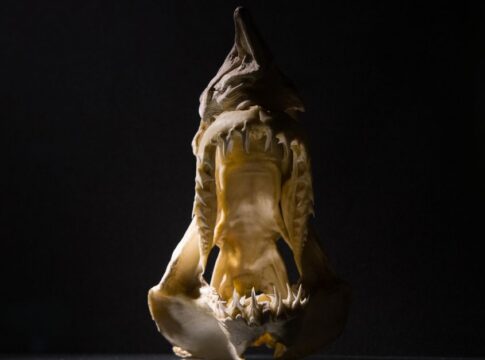
The shark jaw represents one of the most powerful structures in the animal kingdom, entirely constructed from cartilage. A bull shark’s bite force can exceed 1,300 pounds per square inch—comparable to a lion’s bite—all delivered through a cartilaginous jaw system. The jaw’s flexibility actually enhances feeding efficiency, allowing sharks to protrude their jaws forward during biting, increasing gape width by up to 30%.
Shark skulls form a cartilaginous brain case called the chondrocranium, which fully encases and protects the brain. In hammerhead sharks, this cartilage structure extends into the distinctive cephalofoil—the hammer-shaped head extension that can span up to three feet in great hammerhead species. This cartilaginous extension houses sensory organs while remaining light enough not to impair swimming efficiency.
What Happens to Shark Remains
The cartilaginous composition of shark skeletons creates unique challenges for paleontologists. Unlike bones, which readily fossilize through mineralization, cartilage decomposes rapidly after death. This explains why the fossil record for sharks consists primarily of teeth, which contain high mineral content and resist decomposition. Scientists estimate that fewer than 1% of shark species that ever existed have left complete skeletal fossils.
When a shark dies and sinks to the ocean floor, scavengers and bacteria consume the soft cartilage within weeks. A 2019 study tracking whale shark carcasses found that cartilaginous tissues disappeared 3-4 times faster than equivalent mass of muscle tissue. The teeth, composed of dentin and enameloid (essentially modified bone tissue), persist for millions of years. A single shark may shed 30,000 teeth during its lifetime, creating an abundant fossil record of dental structures but leaving gaps in our understanding of extinct shark body structures.
Exceptional fossilization conditions occasionally preserve shark cartilage when rapid burial in fine sediment prevents decomposition and allows mineral replacement. The 350-million-year-old fossils from the Cleveland Shale in Ohio include some of the most complete ancient shark skeletons ever discovered, with preserved cartilage showing the same tessellated structure found in modern species.
Other Marine Animals Without Bones
Sharks share their boneless characteristic with approximately 1,200 other fish species in the class Chondrichthyes. Rays, including manta rays with wingspans reaching 29 feet, navigate oceans using entirely cartilaginous skeletons. Chimaeras, strange deep-sea relatives of sharks sometimes called “ghost sharks,” also rely completely on cartilage. These ratfish species diverged from the shark lineage about 400 million years ago but retained the cartilaginous skeletal system.
Outside the Chondrichthyes class, some primitive fish groups also feature predominantly cartilaginous skeletons. Sturgeon, ancient fish that have existed for 200 million years, possess mainly cartilaginous skeletons with only partial bone development. Lamprey and hagfish—jawless fish that predate sharks evolutionarily—also lack true bone, though their cartilage differs in composition from shark cartilage.
The persistence of cartilaginous skeletons across such diverse species and vast time spans demonstrates that this anatomical feature isn’t a primitive holdover but rather an optimal solution for certain marine lifestyles. While the ancestors of land vertebrates evolved bone to support body weight against gravity, sharks faced no such pressure in their buoyant marine environment.
Common Misconceptions About Shark Anatomy
Many people assume that because sharks lack bones, their bodies must be soft or weak. In reality, the tessellated cartilage in shark skeletons provides comparable strength to bone in many applications while offering superior flexibility. A blacktip reef shark can contort its body into a U-shape during feeding frenzies, a feat impossible for bony fish of similar size.
Another widespread misconception holds that shark cartilage supplements can treat arthritis or cancer. Extensive scientific studies, including clinical trials published in JAMA and the Journal of Clinical Oncology, found no evidence that consuming shark cartilage provides medical benefits for these conditions. The idea originated from the mistaken belief that sharks don’t get cancer—they do, with documented cases of tumors in multiple shark species.
Some people incorrectly believe that all ocean predators lack bones. In fact, most fish species—including predators like tuna, barracuda, and marlin—have fully developed bony skeletons. The cartilaginous condition is specific to sharks, rays, and their close relatives. Even marine mammals like dolphins and whales, which returned to the ocean from land-dwelling ancestors, retained their complete skeletal bone structure.
Frequently Asked Questions
Why don’t sharks have bones like other fish?
Sharks evolved from ancestors that never developed bone tissue, instead perfecting cartilage-based skeletons that provide advantages in their marine environment. The lighter weight, reduced metabolic cost, and increased flexibility of cartilage proved more beneficial for their predatory lifestyle than developing bones would have been.
If sharks have no bones, what gives them their shape and structure?
Sharks maintain their shape through cartilage that’s reinforced with calcium salts in a process called mineralization, creating tessellated structures nearly as rigid as bone. Their thick skin, embedded with tooth-like scales called dermal denticles, also provides structural support and protection.
Can shark cartilage fossilize like bones do?
Shark cartilage rarely fossilizes because it decomposes quickly after death, unlike mineral-rich bones. Only under exceptional conditions—such as rapid burial in oxygen-poor sediment—does cartilage undergo mineral replacement and preservation, making complete shark fossils extremely rare.
Do baby sharks have cartilage from birth?
Yes, shark pups are born with fully cartilaginous skeletons, just like adults. Unlike mammals, where cartilage templates are gradually replaced by bone during development, sharks retain their cartilage throughout their entire lives, with only increased mineralization as they mature.
Key Takeaways
- Sharks and their relatives evolved cartilaginous skeletons that provide optimal buoyancy, flexibility, and energy efficiency for marine predation—advantages that bones cannot match in aquatic environments
- Shark cartilage isn’t weak; tessellated mineralization creates structures approaching bone strength while maintaining significantly lighter weight and greater flexibility for enhanced swimming performance
- The rapid decomposition of cartilage after death means shark fossils consist primarily of teeth, creating significant gaps in paleontological understanding despite sharks’ 400-million-year history
- Over 500 modern shark species thrive with cartilaginous skeletons, demonstrating that this anatomical feature represents a highly successful evolutionary strategy rather than a primitive limitation