
⏱️ 9 min read
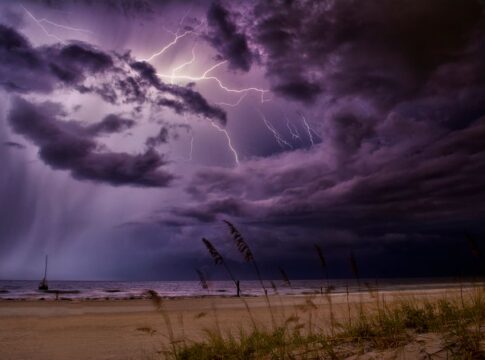
When a bolt of lightning strikes a sandy beach or desert, something extraordinary happens beneath the surface: temperatures soar to 30,000 degrees Celsius—five times hotter than the sun’s surface—and silicon dioxide grains fuse into hollow, glassy tubes. These natural sculptures, called fulgurites, preserve the exact path of the lightning strike in frozen glass. Nature’s most powerful electrical phenomenon creates its own lasting artwork in seconds.
Quick Facts
- Lightning strikes reach temperatures of 30,000°C (54,000°F), hot enough to instantly melt sand into glass.
- Fulgurites are the glassy tubes or crusts formed when lightning strikes sand, soil, or rock.
- A single fulgurite can extend up to 15 meters (49 feet) underground following the lightning’s path.
- The glass created by lightning strikes is primarily made of lechatelierite, a rare silica glass mineral.
- Scientists estimate that Earth experiences approximately 100 lightning strikes every second worldwide.
The Science Behind Lightning-Formed Glass
The transformation of sand into glass requires intense heat applied rapidly. When lightning channels through sand, the electrical current—which can carry up to one billion volts—generates temperatures that dwarf most earthly processes. Silicon dioxide, the primary component of sand, melts at approximately 1,710°C (3,110°F) under normal conditions. The lightning’s heat far exceeds this threshold, liquefying the sand instantaneously.
The resulting material differs significantly from manufactured glass. Fulgurite glass contains numerous air bubbles, trapped sand grains, and an irregular structure reflecting the chaotic energy of the strike. The rapid cooling process—occurring within seconds as the lightning dissipates—prevents the silica molecules from organizing into their normal crystalline structure. Instead, they freeze in an amorphous state, creating true glass. This natural glass formation process mirrors what glassmakers have done artificially for over 4,000 years, though lightning accomplishes in microseconds what human furnaces require hours to achieve.
The composition of fulgurites reveals fascinating details about the strike itself. Scientists have identified trace elements within these structures that vaporized from the surrounding soil or even from the air during the electrical discharge. Studies published in the American Mineralogist journal have documented the presence of rare minerals like mullite and cristobalite within fulgurite specimens, minerals that only form under extreme temperature conditions.
Types and Characteristics of Fulgurites
Fulgurites fall into three distinct categories based on where and how they form. Sand fulgurites, the most commonly recognized type, develop in beach environments, deserts, and sandy soil. These specimens typically appear as hollow tubes with rough, granular outer surfaces and smooth, glassy interiors. Their tube diameters range from pencil-thin (around 1-2 centimeters) to several inches across, depending on the lightning bolt’s energy and the sand’s moisture content.
Rock fulgurites form when lightning strikes solid rock surfaces, creating glassy coatings or crusts rather than tubes. Mount Thielsen in Oregon, nicknamed “the Lightning Rod of the Cascades,” displays numerous rock fulgurites on its summit. Mountaineers have documented glassy patches where repeated strikes have modified the mountain’s volcanic rock surface over centuries.
Clay or soil fulgurites represent the third category, forming in areas with higher clay content or mixed soil compositions. These specimens often branch more extensively than sand fulgurites because the electrical current seeks paths of least resistance through varying soil conductivity. The Guinness World Record for the longest fulgurite recovery belongs to a specimen found in Florida measuring 5.18 meters (17 feet), though researchers believe the complete structure extended much deeper before breaking during excavation.
Where Fulgurites Are Found Around the World
The Sahara Desert hosts extensive fulgurite formations, with particularly notable specimens discovered in Chad and Libya. The dry, sandy conditions combined with frequent thunderstorms during certain seasons create ideal formation circumstances. Some Saharan fulgurites date back thousands of years, preserved by the arid climate that prevents erosion.
The Atlantic coastal regions of the United States—particularly North Carolina, South Carolina, and Florida—yield abundant fulgurite specimens. Florida alone experiences approximately 1.4 million lightning strikes annually, according to the National Weather Service, making it America’s lightning capital. Beachcombers occasionally stumble upon exposed fulgurites after storms erode the sand covering them. Professional collectors and researchers regularly survey these areas following severe weather events.
The Atacama Desert in Chile, one of Earth’s driest places, contains ancient fulgurites that may be tens of thousands of years old. Researchers from Brown University analyzed Atacama fulgurites and determined they could provide climate data spanning millennia. The glass preserves microscopic particles and chemical signatures from the atmosphere at the time of formation, essentially creating time capsules of past environmental conditions.
Australia’s sandy interior regions produce distinctive red-hued fulgurites, colored by iron oxide content in the sand. The Strzelecki Desert and Simpson Desert have yielded specimens studied by the Australian National University. Aboriginal communities in these regions have traditional stories about “lightning roots” that predate European scientific understanding of the phenomenon by centuries.
Scientific Value and Research Applications
Fulgurites serve as natural laboratories for studying extreme temperature and pressure conditions. Materials scientists examine these structures to understand how silica behaves under rapid heating and cooling cycles, research applicable to manufacturing processes and ceramics development. The Naval Research Laboratory has analyzed fulgurite formation to better understand lightning’s effects on military equipment and electronic systems.
Paleoclimatologists extract valuable information from ancient fulgurites. The glass matrix traps atmospheric gases, pollen, and dust from the moment of formation. Dr. Matthew Pasek at the University of South Florida has published research demonstrating that fulgurites can reveal lightning strike frequency over geological timescales. His work suggests that analyzing fulgurite distribution patterns in sedimentary layers helps reconstruct past climate conditions and storm intensity.
Astrobiology researchers study fulgurites as analogs for processes on other planets. Mars, with its silica-rich soil and dust storms, could theoretically produce fulgurites if sufficient atmospheric electricity exists. Understanding terrestrial fulgurite formation helps scientists design instruments to detect similar structures on other worlds. The presence of fulgurites could indicate past or present atmospheric electrical activity on planets where direct observation is challenging.
Collecting and Preserving Lightning Glass
Extracting intact fulgurites requires exceptional care due to their fragile nature. The glass often fractures easily, and the surrounding sand must be carefully excavated to avoid breaking the structure. Professional collectors use plaster jacketing techniques—similar to paleontological excavation methods—to stabilize specimens before removal. The process can take hours for large specimens, with excavators working centimeter by centimeter to expose the fulgurite’s full extent.
The market for fulgurite specimens ranges from small fragments selling for $10-20 to museum-quality pieces commanding thousands of dollars. The Smithsonian Institution houses several notable examples in its mineral collection, including a branching specimen from New Jersey that spans over one meter. Private collectors prize specimens with unusual features: multiple branches, embedded materials, or exceptional length.
Legal considerations affect fulgurite collection in many locations. National parks and protected areas prohibit removing any natural materials, including fulgurites. Some states classify fulgurites as minerals subject to collection regulations, while others have no specific laws addressing them. Responsible collectors always obtain landowner permission and verify local regulations before excavating specimens.
Historical and Cultural Significance
Ancient peoples encountered fulgurites long before understanding their origin. Some cultures incorporated them into spiritual practices, viewing them as solidified lightning or gifts from sky deities. Archaeological evidence from Bronze Age sites in the Middle East suggests that early peoples occasionally collected these curious objects, though whether they recognized any connection to lightning remains unclear.
The scientific community first documented fulgurites in 1706 when Pastor David Hermann described glassy tubes found in sandy German soil after thunderstorms. However, the connection to lightning wasn’t definitively established until the 19th century, when controlled experiments and field observations confirmed the formation mechanism. The term “fulgurite” derives from the Latin “fulgur,” meaning thunderbolt, coined by British mineralogist Charles Darwin (not the famous naturalist) in 1856.
Native American tribes in the southwestern United States incorporated fulgurite fragments into ceremonial objects and tools. Some anthropologists suggest that the recognition of lightning’s glass-forming ability may have influenced early glassmaking attempts, though direct evidence for this connection remains speculative. What’s certain is that humans across cultures recognized these objects as special, even when their origin remained mysterious.
Frequently Asked Questions
How long does lightning glass last in nature?
Fulgurites can persist for thousands to millions of years in stable environments like deserts, where erosion is minimal. In coastal or wet environments, they typically survive decades to centuries before weathering destroys them. The oldest confirmed fulgurites, found in fossilized sand deposits, date back approximately 250 million years.
Can you make glass from sand using methods other than lightning?
Yes, humans have manufactured glass from sand for over 4,000 years by heating silica sand to approximately 1,700°C with flux additives like soda ash and limestone that lower the melting point. However, lightning creates pure silica glass (lechatelierite) without additives, requiring much higher temperatures than conventional glassmaking.
Is it dangerous to dig for fulgurites?
The primary danger comes from excavating in areas prone to lightning strikes, particularly during active thunderstorms. The fulgurites themselves pose no inherent hazard, though sharp edges can cut skin. Always check weather forecasts and never search during electrical storms, as lightning frequently strikes the same general area multiple times.
How much energy does it take to create a fulgurite?
A typical lightning bolt carries between 1 and 5 billion joules of energy, though only a small fraction (roughly 20-30%) actually heats the ground. Even this partial energy transfer generates enough heat to melt and fuse several kilograms of sand along the strike channel within milliseconds.
Key Takeaways
- Lightning strikes transform ordinary sand into hollow glass tubes called fulgurites through temperatures exceeding 30,000°C, creating natural sculptures that preserve the exact path of the electrical discharge.
- These geological formations serve valuable scientific purposes, from revealing ancient atmospheric conditions to helping researchers understand extreme temperature material processes relevant to multiple fields.
- Fulgurites exist worldwide in sandy environments, with particularly notable specimens found in coastal regions, deserts, and high-altitude locations prone to frequent lightning activity.
- The glass formed by lightning differs structurally from manufactured glass, consisting of pure silica frozen in an amorphous state with trapped air bubbles, minerals, and particles that record the moment of creation.