
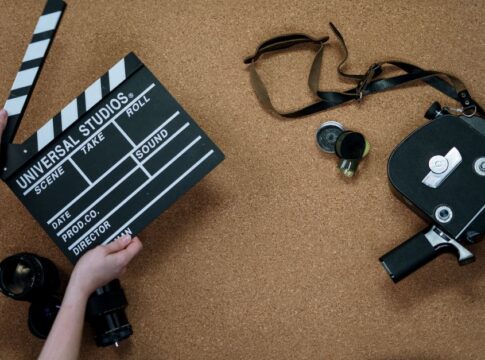
Why Movie Credits Roll Upward Instead of Downward
By Trivia Daily, Staff Writer — Published September 5, 2026
Table of Contents
- Key Takeaways
- The Reading Direction That Feels Right
- How Early Film Technology Shaped the Choice
- When Movie Credits Started Rolling at All
- Comparing Credit Movement Options
- Why Digital Filmmaking Keeps the Tradition
- Frequently Asked Questions
Every time you settle in to watch a film, whether in a darkened theater or on your couch at home, you witness a peculiar phenomenon: movie credits roll upward from the bottom of the screen to the top. This upward motion feels so natural that most viewers never question it. Yet the choice to make movie credits roll in this specific direction wasn’t arbitrary—it emerged from the practical limitations of early film technology and the fundamental way humans read. Discovering the reasons behind this cinematic convention reveals surprising facts about how our brains process information and how filmmakers adapted to mechanical constraints.
The upward roll has become so deeply embedded in film culture that reversing it would feel disorienting, even wrong. But why did this particular direction win out over all other possibilities?
Key Takeaways
- Movie credits roll upward because early optical printers and film cameras could only capture text moving in one direction efficiently, and upward motion matched natural reading patterns.
- Human eyes read more comfortably when text enters from below their focal point and exits above, creating less strain than downward-scrolling text.
- The first scrolling film credits appeared in the 1930s, but the practice didn’t become standard until the 1960s when union rules expanded credit requirements.
- Downward-scrolling credits would require viewers to constantly shift their gaze downward, fighting against the natural tendency to look upward as they finish reading each line.
- Modern digital technology could easily produce credits in any direction, but upward rolling remains the standard because audiences expect it and find it most comfortable.
The Reading Direction That Feels Right
When you read a page in a book, your eyes move left to right across each line, then drop down to the next line. Movie credits roll upward to work with this natural reading rhythm rather than against it. As text scrolls up from the bottom of the screen, your eyes can settle near the middle of the frame, reading each name or title as it passes through your comfortable focal zone before it disappears at the top.
If credits rolled downward instead, you’d need to catch each line at the top of the screen and track it all the way to the bottom—essentially reading “backwards” against your ingrained habits. Your gaze would constantly chase the text downward, creating more eye strain and fatigue. Upward motion allows your eyes to stay relatively still while the text comes to you, passes through your reading zone, and exits naturally above.
This isn’t just about comfort. It’s about comprehension. Studies of reading patterns show that people process information more efficiently when their eyes can maintain a steady focal point. The upward scroll delivers text to that sweet spot in the center of your vision, then removes it cleanly from above.
How Early Film Technology Shaped the Choice
Before digital effects, creating scrolling credits required ingenious mechanical solutions. Filmmakers used optical printers—specialized cameras that photographed artwork or text one frame at a time. To create the illusion of upward motion, technicians would place a long sheet of paper or board with typed credits in front of the camera, then slowly pull it upward while the camera captured each frame.
This upward pull was mechanically simpler than pushing downward. Gravity naturally helped the credit sheet hang straight and taut when pulled from above, preventing wobbles or bends that would show on screen. Pushing from below would have required more complex rigging to keep everything stable and aligned. The physical setup—with credits mounted vertically and pulled upward past a fixed camera—became the industry standard because it was the most reliable method available.
Early optical printers also used this configuration because it matched how film itself moved through projectors and cameras—feeding upward through the gate. Engineers designed equipment that worked harmoniously with existing film transport mechanisms, and upward-scrolling credits fit naturally into that workflow.
When Movie Credits Started Rolling at All
For decades, film credits didn’t roll at all. Silent films and early talkies displayed credits as static title cards that appeared one after another. Each card would fade in, remain on screen for a few seconds, then fade out before the next one appeared. This method worked fine when films had small crews and only a handful of people to credit.
As Hollywood productions grew more complex in the 1930s and 1940s, credit lists expanded. Studios began experimenting with scrolling credits to save time and maintain audience attention. The technique remained relatively rare until the 1960s and 1970s, when labor unions negotiated contracts requiring studios to credit more crew members. Suddenly, films needed to acknowledge dozens or even hundreds of contributors. Scrolling credits became a practical necessity.
The upward roll had already established itself as the standard method by this point, so when credits exploded in length, filmmakers simply extended the scroll rather than reconsidering the direction.
Comparing Credit Movement Options
| Direction | Reading Comfort | Technical Ease (Film Era) | Modern Use |
|---|---|---|---|
| Upward scroll | High—eyes stay centered | Simple mechanical setup | Industry standard |
| Downward scroll | Low—eyes chase text down | Difficult rigging required | Rarely seen |
| Static cards | Moderate—no eye tracking needed | Very simple | Occasional artistic choice |
| Side-to-side crawl | Low—unnatural for block text | Requires horizontal setup | Used only for single-line news tickers |
Why Digital Filmmaking Keeps the Tradition
Today’s filmmakers create credits entirely on computers. Software can make text move in any direction—upward, downward, diagonally, in spirals, or in complex three-dimensional patterns. Yet the overwhelming majority of films still use the classic upward scroll. Why abandon digital freedom for an old convention?
The answer lies in audience expectations and genuine ergonomic benefits. Viewers have watched upward-rolling credits for generations. The pattern feels correct because it is correct for how our visual systems work. Filmmakers who experiment with other directions often find that audiences react negatively, describing the credits as “wrong” or “uncomfortable” even if they can’t articulate why.
Some experimental or artistic films do play with credit presentation, using unconventional directions or animated sequences. These choices work when they’re clearly intentional creative statements. But for mainstream cinema, the upward roll remains unbeatable for its combination of readability, tradition, and viewer comfort.
Frequently Asked Questions
Do any movies use downward-scrolling credits?
Downward-scrolling credits are extremely rare in professional cinema. A few experimental or art films have used them for specific stylistic effect, but they’re uncomfortable for most viewers and violate industry convention. Television news tickers sometimes scroll downward, but these display only single lines of text, not full credit blocks.
When did scrolling credits become mandatory?
Scrolling credits aren’t legally mandatory, but union contracts from the 1960s onward required studios to credit more crew members, making scrolling practical. The Directors Guild of America, Screen Actors Guild, and other unions negotiated specific credit requirements that expanded the lists significantly, turning scrolling credits from occasional practice into industry standard.
How fast should movie credits scroll?
Most films scroll credits at speeds between 20 and 30 lines per minute, though there’s no official standard. The speed must be slow enough for average readers to comprehend names while fast enough to avoid boring the audience. End credits for major blockbusters can run five to ten minutes at typical speeds.
Why do some credits appear as static cards instead of rolling?
Opening credits and key personnel often appear as individual static title cards for emphasis and prestige. Directors, lead actors, and producers may negotiate for their names to appear separately rather than in a scroll, giving them more screen time and prominence. This practice honors the tradition of early cinema while highlighting the most important contributors.
The next time you watch movie credits roll upward, you’re witnessing a perfect marriage of human physiology, mechanical history, and cultural expectation. What started as the most practical solution for 1930s optical printers became the most comfortable reading experience for modern audiences—a rare case where the path of least resistance led to the genuinely best outcome.