
Why Pianos Have 88 Keys Instead of More or Fewer
By Trivia Daily, Staff Writer — Published August 24, 2026
Table of Contents
- Key Takeaways
- The Evolution from 60 to 88 Piano Keys Instead of Staying Small
- Why Not 100 or 120 Keys? The Science of Human Hearing
- Comparing Piano Configurations Across History
- The Physical Realities of String Length and Concert Halls
- Amazing Facts About Piano Key Distribution
- Frequently Asked Questions
The modern piano sits in living rooms, concert halls, and practice studios around the world with a seemingly arbitrary number: 88 keys. Not 80, not 100, but exactly 88. This number wasn’t chosen by committee or plucked from thin air. The story behind why pianos have this specific number of keys instead of more or fewer reveals fascinating truths about human hearing, instrument evolution, and the practical limits of music itself. For anyone curious about the hidden logic behind everyday objects, the piano keyboard offers a surprising window into centuries of musical discovery.
The 88-key configuration emerged from a gradual evolution spanning more than 150 years, balancing the physical capabilities of human hearing with the mechanical realities of piano construction. What makes this trivia even more interesting is that early pianos looked nothing like what we see today.
Key Takeaways
- The 88-key piano became the standard in the 1880s, featuring 52 white keys and 36 black keys spanning seven octaves plus a minor third.
- Early pianos from the 1700s had only 60 keys, covering five octaves, because composers hadn’t yet written music requiring a wider range.
- The range of 88 keys (from A0 to C8) closely matches the practical limits of human pitch perception, with frequencies from about 27.5 Hz to 4,186 Hz.
- Steinway & Sons standardized the 88-key format in the 1880s, and other manufacturers followed to ensure compatibility with expanding musical repertoires.
- Adding more keys would produce frequencies either too low or too high for most people to distinguish as distinct musical pitches.
- The physical length of piano strings and the size of concert halls also influenced the practical upper limit of the keyboard.
The Evolution from 60 to 88 Piano Keys Instead of Staying Small
When Bartolomeo Cristofori invented the piano around 1700 in Italy, his instruments featured roughly 54 keys. This was already an expansion from the harpsichord, which typically had even fewer. For the music of that era—think Bach and Handel—five octaves provided ample range. Composers wrote within the limitations of available instruments, and performers didn’t miss what they’d never had.
As the 18th century progressed, piano makers began adding keys. By Mozart’s time, pianos commonly featured 61 keys, spanning five octaves. Beethoven pushed boundaries further, and piano manufacturers responded by expanding to six octaves (73 keys) and eventually beyond. The relationship between composers and instrument makers became a fascinating feedback loop: composers demanded greater range, builders expanded keyboards, and the new range inspired composers to explore fresh musical territory.
The standardization at 88 keys occurred during the 1880s when Steinway & Sons established this configuration as optimal. Other manufacturers adopted the same standard to ensure that sheet music and compositions would be universally playable. This remarkable example of industrial standardization happened without formal regulation—market forces and musical necessity drove consensus.
Why Not 100 or 120 Keys? The Science of Human Hearing
The human ear can detect frequencies roughly between 20 Hz and 20,000 Hz, but musical pitch perception operates within narrower boundaries. The lowest note on an 88-key piano, A0, vibrates at approximately 27.5 Hz. The highest note, C8, rings at about 4,186 Hz. These endpoints weren’t chosen randomly.
Below A0, frequencies become difficult for most listeners to perceive as distinct pitches rather than rhythmic pulses. The sound feels more like rumbling than music. Some specialty instruments like the Bösendorfer Imperial Grand do include extra bass keys extending down to C0, but these nine additional notes serve primarily to add sympathetic resonance rather than function as regularly played notes. They vibrate in sympathy with other strings, enriching the overall tone.
At the upper extreme, notes above C8 become thin and difficult to tune accurately. The strings required would be so short and tight that maintaining stable pitch becomes mechanically challenging. Human ears also struggle to distinguish exact pitches at these extreme frequencies—the notes start blending together perceptually. The 88-key range captures the sweet spot where musical expression, mechanical feasibility, and human perception align.
Comparing Piano Configurations Across History
| Era | Number of Keys | Range | Notable Context |
|---|---|---|---|
| Early 1700s | 54–60 | 4.5–5 octaves | Cristofori’s original pianos; suitable for Baroque music |
| Late 1700s | 61 | 5 octaves | Mozart-era instruments; most common during Classical period |
| Early 1800s | 73 | 6 octaves | Beethoven’s later works pushed this range |
| Mid 1800s | 85 | 7 octaves | Romantic composers exploited expanded tonal palette |
| 1880s–Present | 88 | 7 octaves + minor third | Industry standard established; works for all repertoire |
The Physical Realities of String Length and Concert Halls
Piano design involves elegant engineering compromises. Bass strings must be long and heavy to vibrate at low frequencies—the lowest strings on a concert grand can exceed six feet in length. Treble strings are short and thin, sometimes just a couple of inches long. Extending the range further in either direction would require either impractically long bass strings or impossibly delicate treble strings that would break constantly.
Concert hall acoustics also play a role. Sound waves from extremely low frequencies require large spaces to develop properly. Very high frequencies dissipate quickly and can sound harsh in reverberant spaces. The 88-key range produces frequencies that work well in venues ranging from intimate recital halls to large concert auditoriums. This versatility contributed to the configuration’s staying power.
Amazing Facts About Piano Key Distribution
The 88 keys break down into a specific pattern that reveals the instrument’s mathematical elegance:
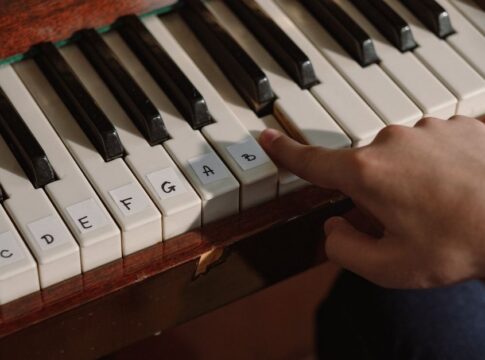
- 52 white keys represent the natural notes (A, B, C, D, E, F, G) across the range
- 36 black keys represent the sharps and flats, arranged in alternating groups of two and three
- The pattern repeats every 12 keys (one octave), creating visual landmarks that help pianists navigate without looking
- The keyboard spans exactly 7 octaves plus a minor third (A to C)
- The starting note is A rather than C, a historical quirk from how musical scales were originally organized
This layout creates a tactile map that skilled pianists can read with their fingers, enabling them to play complex music in dimly lit concert halls. The alternating black key groups of two and three serve as reference points—every pianist learns to find middle C by locating the group of two black keys.
Frequently Asked Questions
Do all pianos have exactly 88 keys?
Most full-size acoustic and digital pianos have 88 keys, but smaller instruments exist. Upright spinets might have 85 keys, while keyboards for beginners often feature 61 or 76 keys. A few specialty concert grands, like the Bösendorfer Imperial, include 97 keys with extra bass notes.
Who decided that pianos should have 88 keys?
No single person or organization mandated 88 keys. Steinway & Sons popularized this configuration in the 1880s, and other manufacturers adopted it as composers like Liszt and Brahms wrote music utilizing the full range. Market standardization emerged organically through practical necessity.
Can humans actually hear the difference between all 88 keys?
Yes, trained musicians can distinguish between adjacent keys across the entire 88-key range. However, the extreme low and high notes approach the limits where pitch perception becomes less precise. The middle range offers the clearest pitch differentiation.
Why don’t modern pianos have more keys since technology has improved?
The 88-key range already extends to the practical limits of musical pitch perception and string physics. Adding more keys would produce sounds that are difficult to tune, maintain, or perceive as distinct musical notes. The existing range accommodates all composed piano literature from the past three centuries.
The next time you see a piano, those 88 keys represent more than black and white patterns. They embody centuries of experimentation, the boundaries of human hearing, and the collective wisdom of composers and craftspeople who discovered that sometimes, a specific number isn’t arbitrary at all—it’s exactly right.