
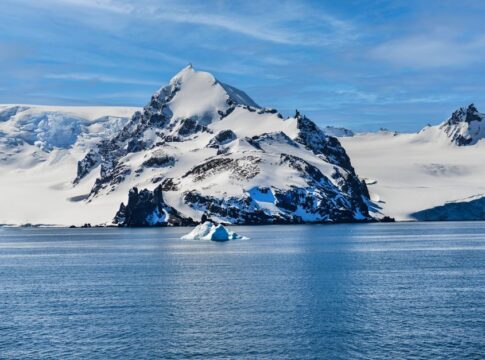
Why Antarctica Has No Permanent Residents But Has ATMs
By Trivia Daily, Geography Desk — Published October 5, 2026
Table of Contents
- Key Takeaways
- Why Antarctica Permanent Residents Don’t Exist
- The Surprising Infrastructure of Research Stations
- The Antarctic Treaty and International Geography
- Comparing Antarctica to Other Continents
- Life at the Edge of Human Capability
- Frequently Asked Questions
Antarctica stands alone as the only continent without permanent residents, yet it boasts at least two functioning ATMs. This paradox captures the essence of Earth’s southernmost landmass: a place simultaneously too harsh for human settlement and sophisticated enough to support modern banking infrastructure. The continent’s extreme environment prevents anyone from claiming it as a true home, while international scientific research stations maintain surprisingly robust facilities for temporary inhabitants who rotate in and out with the seasons.
The ATMs exist at McMurdo Station, the largest research facility in Antarctica, operated by the United States. They serve the rotating population of scientists, support staff, and researchers who work there temporarily. While you won’t find any native-born Antarcticans or permanent addresses on this frozen continent, the presence of cash machines reveals how humans have carved out a temporary foothold in one of Earth’s most extreme places.
Key Takeaways
- Antarctica has no permanent residents because no one is born there or lives there year-round indefinitely, though it hosts temporary research populations that can exceed 5,000 in summer.
- At least two ATMs operate at McMurdo Station, maintained by Wells Fargo, making them the southernmost cash machines in the world.
- The Antarctic Treaty of 1959 prohibits military activity and mineral mining while promoting scientific research, with 54 countries now party to the agreement.
- Winter temperatures can plummet below -80°F (-62°C) in the interior, while the continent holds about 90% of Earth’s ice and 70% of its fresh water.
- The continent is larger than Europe, covering approximately 5.5 million square miles, making it the fifth-largest continent by area.
- No country owns Antarctica, though seven nations maintain territorial claims that are not universally recognized under international law.
Why Antarctica Permanent Residents Don’t Exist
The definition of a permanent resident typically requires either being born in a location or maintaining continuous, indefinite residence there. Antarctica fails both tests. No one has ever been born on the continent and chosen to remain there for life. While some researchers spend years working at Antarctic stations over multiple deployments, they always return to their home countries. They maintain citizenship elsewhere, own property in warmer climates, and eventually retire far from the ice.
The environment itself makes permanent settlement impossible under current technology. Antarctica is a polar desert, the driest continent on Earth despite all its ice. The interior receives less precipitation than the Sahara. Temperatures in winter create conditions incompatible with conventional human habitation. The sun disappears for months during polar night, returning only for the continuous daylight of polar summer. No terrestrial plants grow there for food. No indigenous land mammals exist to hunt.
Even with modern technology, survival requires constant resupply from other continents. Food, fuel, medical supplies, and replacement parts must arrive by ship or aircraft. A true permanent resident would need to be entirely self-sufficient, which remains beyond current capabilities in such an extreme environment.
The Surprising Infrastructure of Research Stations
McMurdo Station operates like a small town during the austral summer, hosting over 1,000 people at peak times. The facility includes dormitories, laboratories, a firehouse, a water treatment plant, and even a greenhouse where fresh vegetables grow under artificial light. The two ATMs serve practical purposes: researchers and support staff need cash for the station’s small stores and recreational facilities.
Wells Fargo services these machines, which require special maintenance given the extreme cold. Technicians must travel to Antarctica to perform repairs and replenish cash supplies. The machines dispense U.S. dollars, the de facto currency at American research stations, though most transactions happen electronically.
Other stations across Antarctica maintain similarly sophisticated infrastructure. Russia’s Vostok Station, located near the coldest temperature ever recorded on Earth, has operated since 1957. The Amundsen-Scott South Pole Station sits at the geographic South Pole itself, rebuilt in 2008 with modern facilities. These outposts demonstrate human engineering prowess while underscoring that even our best technology only permits temporary stays.
The Antarctic Treaty and International Geography
Antarctica’s unique status in world geography stems from the Antarctic Treaty System. Before 1959, seven countries claimed wedge-shaped territories radiating from the South Pole: Argentina, Australia, Chile, France, New Zealand, Norway, and the United Kingdom. Some of these claims overlapped, creating potential conflicts.
The Antarctic Treaty froze these disputes without resolving them. No new claims can be made, and existing claims are neither recognized nor rejected. The continent functions as a scientific preserve and natural reserve. Military activity is banned except for peaceful purposes like logistical support. Nuclear explosions and radioactive waste disposal are prohibited. The treaty dedicates Antarctica to peace and science.
This international cooperation makes Antarctica unlike any other place on Earth’s maps. It belongs to no nation, yet all nations can conduct research there. The arrangement has held for over six decades, making it one of the most successful international agreements in history.
Comparing Antarctica to Other Continents
| Continent | Approximate Area (million sq mi) | Permanent Population | Countries |
|---|---|---|---|
| Asia | 17.2 | 4.7 billion | 48 |
| Africa | 11.7 | 1.4 billion | 54 |
| North America | 9.5 | 592 million | 23 |
| South America | 6.9 | 434 million | 12 |
| Antarctica | 5.5 | 0 | 0 |
| Europe | 3.9 | 748 million | 44 |
| Australia/Oceania | 3.3 | 44 million | 14 |
Life at the Edge of Human Capability
The people who work in Antarctica don’t consider themselves residents in any meaningful sense. They’re temporary visitors, even those who return season after season. Staff members sign contracts for specific periods, typically ranging from a few months to just over a year. Before deployment, they undergo medical and psychological screening. The isolation, darkness, and cold test human endurance.
Summer populations swell as ships and aircraft can more easily reach the continent. Winter populations shrink dramatically. Those who “winter over” experience months of darkness, extreme cold, and complete isolation. No planes can land during the harshest winter months. Medical evacuation becomes impossible. The winter crew must be self-reliant until spring.
Despite these hardships, positions at Antarctic stations remain competitive. Scientists prize the opportunity to conduct research impossible anywhere else. Support staff appreciate the adventure and unique experience. But everyone knows they’re temporary visitors to a continent that tolerates human presence but will never welcome permanent settlement.
Frequently Asked Questions
Has anyone ever been born in Antarctica?
Yes, at least eleven people have been born in Antarctica, mostly at Argentine and Chilean bases where some personnel brought their families. However, none of these individuals remained on the continent permanently or established permanent residency there.
Why does Antarctica have ATMs if no one lives there permanently?
The ATMs at McMurdo Station serve the temporary population of researchers and support staff who need cash for the station’s stores, cafeteria, and other facilities. They’re maintained because the station operates year-round with rotating personnel who use U.S. currency.
Can you visit Antarctica as a tourist?
Yes, approximately 40,000 to 75,000 tourists visit Antarctica annually, primarily via cruise ships from South America. Visitors must follow strict environmental protocols under the Antarctic Treaty System and cannot stay permanently or establish any kind of residence.
What is the warmest temperature ever recorded in Antarctica?
The World Meteorological Organization confirmed a temperature of 64.9°F (18.3°C) at Esperanza Base on the Antarctic Peninsula in February 2020, making it the highest temperature reliably recorded on the continent.
The next time you withdraw cash from an ATM, consider that two of these machines operate closer to the South Pole than to any major city. They stand as monuments to human ingenuity and our determination to explore every corner of the globe, even places we can never truly call home.