
9 Bizarre Facts About Ancient Roman Concrete Still Standing
By Trivia Daily, History Desk — Published October 7, 2026
Table of Contents
- Key Takeaways
- The Volcanic Secret in Bizarre Ancient Roman Construction
- How Seawater Makes Roman Concrete Stronger
- Nine Remarkable Facts About This Ancient Material
- Comparing Roman and Modern Concrete
- Why Modern Construction Abandoned the Roman Method
- Frequently Asked Questions
Walk through Rome today and you’ll find structures built over two thousand years ago still standing strong. The Pantheon’s massive dome, ancient harbors, and aqueducts defy modern expectations about concrete longevity. While contemporary concrete often crumbles within decades, Roman concrete has survived millennia of earthquakes, saltwater erosion, and the relentless march of time. The secret? A recipe so sophisticated that modern scientists are only now beginning to understand its chemistry.
These bizarre ancient Roman engineering achievements weren’t accidents. Roman builders developed a material that actually grows stronger with age, particularly when exposed to seawater. This remarkable innovation from one of history’s greatest empires challenges everything we thought we knew about construction materials and offers lessons for our own era of infrastructure.
Key Takeaways
- Roman concrete structures have survived over 2,000 years while modern concrete often deteriorates within 50 to 100 years
- The secret ingredient was volcanic ash mixed with lime and seawater, creating a chemical reaction that strengthens over time
- Roman marine concrete actually becomes more durable when exposed to saltwater, unlike modern concrete which corrodes
- The Pantheon’s unreinforced concrete dome remains the world’s largest after nearly two millennia
- Romans used less energy-intensive production methods than modern cement manufacturing, making their process more environmentally sustainable
- Scientists have discovered that Roman concrete contains rare minerals that form through long-term seawater exposure
The Volcanic Secret in Bizarre Ancient Roman Construction
Roman concrete relied on a specific type of volcanic ash called pozzolana, found in abundance near Mount Vesuvius and throughout the Italian peninsula. This ash contained high levels of silica and alumina that reacted chemically with lime and seawater to create an extraordinarily durable binding material. The Romans didn’t understand the chemistry, but centuries of experimentation taught them which volcanic deposits produced the strongest results.
The process differed fundamentally from modern Portland cement. Romans mixed volcanic ash with lime and chunks of volcanic rock, then added seawater for coastal structures. This combination triggered a pozzolanic reaction that continued for years, even centuries, after the initial construction. Modern concrete, by contrast, reaches maximum strength within weeks and then slowly deteriorates.
Researchers have found that the volcanic ash came from specific regions of Italy, and Romans established supply chains to transport it across their vast empire. The quality of pozzolana varied by location, and experienced builders knew which sources produced the most reliable concrete for different applications.
How Seawater Makes Roman Concrete Stronger
Perhaps the most counterintuitive discovery about Roman concrete is that saltwater exposure makes it more durable. When seawater permeates Roman concrete, it dissolves components of the volcanic ash and triggers the growth of interlocking crystals, including a rare mineral called aluminum tobermorite. These crystals fill microscopic cracks and reinforce the structure at a molecular level.
Modern concrete faces the opposite fate. Saltwater corrodes the steel reinforcement bars inside, causing expansion, cracking, and eventual structural failure. Coastal infrastructure built with contemporary materials requires constant maintenance and often needs replacement within decades. Roman harbor installations, built without any steel reinforcement, have withstood two thousand years of wave action and remain structurally sound.
This self-healing property represents a fundamentally different approach to material science. Rather than resisting environmental forces, Roman concrete harnesses them to become stronger. Scientists are now attempting to recreate this process for modern applications, particularly in marine environments where infrastructure faces relentless saltwater exposure.
Nine Remarkable Facts About This Ancient Material
1. The Pantheon’s Dome Remains Unreinforced After 1,900 Years
The Pantheon in Rome, completed around 128 CE, features a concrete dome spanning 142 feet in diameter. No steel reinforcement supports this massive structure, yet it remains the world’s largest unreinforced concrete dome. The Romans varied the concrete mixture throughout the dome’s height, using lighter volcanic aggregates near the top to reduce weight while maintaining strength. This engineering sophistication demonstrates an understanding of material properties that wouldn’t be formally codified until centuries later.
2. Roman Concrete Contains Crystals That Don’t Exist in Nature
When scientists analyzed samples of Roman marine concrete under electron microscopes, they discovered crystals of aluminum tobermorite and phillipsite growing within the material. These minerals form only under specific conditions of heat, pressure, and chemical composition. The slow crystallization process continues for centuries, progressively strengthening the concrete. Modern concrete contains none of these beneficial minerals and lacks the capacity for this type of long-term improvement.
3. Ancient Harbor Structures Outlasted Modern Breakwaters
Roman harbor installations throughout the Mediterranean have survived while modern concrete breakwaters built in the same locations have failed. In Caesarea, Israel, the ancient Roman harbor built by Herod the Great around 15 BCE still stands, while a modern breakwater constructed nearby in the 20th century quickly deteriorated. The difference lies in the material’s response to seawater: Roman concrete grows denser while modern concrete erodes.
4. The Recipe Required Less Heat Than Modern Cement
Manufacturing modern Portland cement requires heating limestone to approximately 1,450 degrees Celsius, a process that consumes enormous amounts of energy and produces significant carbon dioxide emissions. Roman concrete production required much lower temperatures, around 900 degrees Celsius, to create lime. This made the Roman process more energy-efficient and environmentally sustainable, though the Romans themselves weren’t concerned with carbon footprints.
5. Romans Built Concrete Underwater Without Modern Equipment
Roman engineers constructed harbor installations and bridge foundations directly in water using a technique that seems impossible without modern technology. They built wooden forms and poured a mixture of volcanic ash, lime, and seawater directly into seawater. The chemical reaction between the mixture and surrounding water caused it to set and harden even while submerged. This underwater concrete became harder than structures built on dry land.
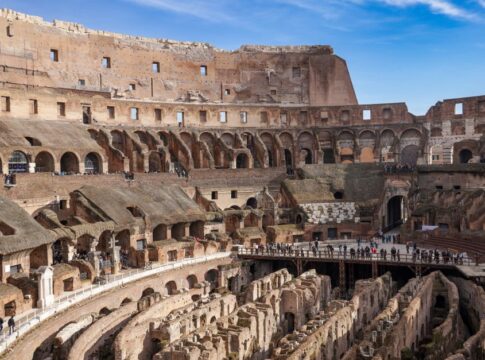
6. The Colosseum’s Foundation Uses Miles of Concrete
Beneath the Colosseum’s visible stone facade lies a massive concrete foundation that has supported the structure’s weight since 80 CE. The foundation extends deep into the ground and spreads the load of the massive amphitheater across a wide area. Despite earthquakes that have damaged the stone superstructure, the concrete foundation remains intact and functional after nearly two millennia.
7. Roman Aqueduct Concrete Resisted Millennia of Water Flow
The interior surfaces of Roman aqueducts carried flowing water for centuries without significant erosion. Modern concrete water channels often develop leaks and structural problems within decades due to chemical reactions between water and concrete. Roman concrete’s composition made it resistant to this type of deterioration, allowing some aqueducts to function for over 500 years of continuous use.
8. The Formula Was Lost for Over a Thousand Years
After the fall of the Western Roman Empire in the 5th century CE, the knowledge of how to make Roman concrete disappeared. Medieval builders couldn’t replicate the material’s properties and instead relied on stone and brick construction. The formula remained lost until modern scientists began analyzing surviving Roman structures in the 20th and 21st centuries using advanced chemical analysis techniques.
9. Modern Scientists Are Still Perfecting the Recreation
Despite understanding the basic chemistry of Roman concrete, scientists haven’t yet fully replicated its properties in modern applications. Variables including the exact composition of volcanic ash, the ratio of ingredients, mixing techniques, and curing conditions all affect the final product. Researchers continue experimenting with different volcanic ash sources and mixture proportions, hoping to create a modern concrete that matches Roman durability while meeting contemporary building codes and performance standards.
Comparing Roman and Modern Concrete
| Property | Roman Concrete | Modern Portland Cement Concrete |
|---|---|---|
| Typical Lifespan | 2,000+ years (still standing) | 50-100 years |
| Saltwater Exposure | Strengthens over time | Causes corrosion and failure |
| Production Temperature | ~900°C | ~1,450°C |
| Key Ingredient | Volcanic ash (pozzolana) | Ground limestone and clay |
| Strength Development | Continues for centuries | Peaks within weeks |
Why Modern Construction Abandoned the Roman Method
Modern concrete dominates construction not because it’s more durable, but because it’s faster and more predictable. Portland cement concrete reaches working strength within days, allowing rapid construction schedules. Roman concrete required weeks or months to develop sufficient strength, making it impractical for modern building timelines. Steel reinforcement allows modern concrete to span greater distances and support heavier loads than unreinforced Roman concrete could manage.
The specific volcanic ash Romans used isn’t available worldwide, creating supply chain challenges. While volcanic deposits exist in many regions, their chemical composition varies significantly. Not all volcanic ash produces the beneficial pozzolanic reaction that made Roman concrete exceptional. This geographical limitation would complicate widespread adoption of Roman techniques.
Building codes and engineering standards evolved around Portland cement’s properties. Structural engineers understand how modern concrete behaves under various loads and conditions. Introducing a material that strengthens over decades rather than weeks would require fundamental changes to design calculations, safety factors, and inspection protocols.
Frequently Asked Questions
Why is Roman concrete stronger than modern concrete?
Roman concrete isn’t necessarily stronger initially, but it becomes more durable over time due to chemical reactions between volcanic ash, lime, and seawater that create crystalline structures. These crystals fill microscopic cracks and reinforce the material, while modern concrete typically deteriorates with age.
Can we still make Roman concrete today?
Scientists can approximate Roman concrete using volcanic ash and similar mixing techniques, but perfect replication remains challenging. Variables in volcanic ash composition, curing conditions, and construction methods all affect the final product’s properties, and researchers continue refining the process.
What is the oldest Roman concrete structure still standing?
Several Roman concrete structures date to the 2nd and 1st centuries BCE, with harbor installations and foundation work among the oldest. The Pantheon, completed around 128 CE, is the most famous and best-preserved example of Roman concrete architecture.
Why did the Romans stop using their concrete formula?
The knowledge wasn’t intentionally abandoned but gradually lost during the decline and fall of the Western Roman Empire. As centralized Roman authority collapsed, the specialized knowledge of master builders and engineers dispersed, and subsequent civilizations developed different construction techniques.
The concrete beneath our feet today will likely crumble long before Roman structures finally fall. That simple fact should humble modern engineers and inspire us to look backward as often as we look forward. Sometimes the most advanced technology isn’t the newest, but the one that stands the test of time measured not in years, but in millennia.