
⏱️ 8 min read
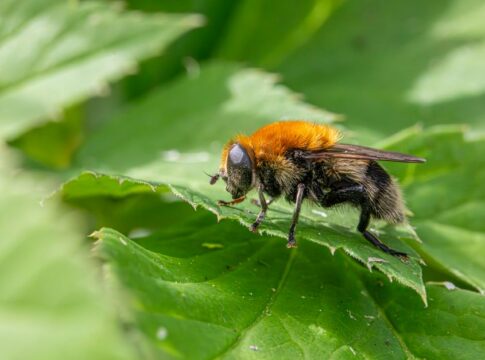
In the brutal arms race of survival, some of the smallest creatures have evolved one of nature’s most cunning strategies: looking like something far more dangerous than they actually are. Across forests, meadows, and tropical jungles, harmless insects masquerade as venomous snakes, stinging wasps, and toxic butterflies, fooling predators with costumes perfected over millions of years.
Quick Facts
- Batesian mimicry occurs when harmless species evolve to resemble dangerous ones, gaining protection without the metabolic cost of producing venom or toxins.
- The hoverfly family contains over 6,000 species, many of which mimic bees, wasps, and other stinging insects with remarkable accuracy.
- Some caterpillars can inflate specialized segments to create realistic snake-head illusions complete with false eyes and triangular shapes.
- Clearwing moths have evolved transparent scales and yellow-black banding to mimic wasps so convincingly that even experienced entomologists initially mistake them.
- Müllerian mimicry involves multiple dangerous species converging on similar warning patterns, which some harmless insects then exploit as a third-party mimic.
1. Spicebush Swallowtail Caterpillar Mimics Green Tree Vipers
The larva of Papilio troilus transforms its front segments into a startlingly accurate snake head when threatened, complete with large false eyespots and a swollen, triangular shape resembling a viper’s head. This North American caterpillar even positions itself in an S-curve pose typical of a coiled snake preparing to strike. The eyespots contain reflective scales that create a wet, glossy appearance matching the eyes of actual reptiles, and the caterpillar can maintain this defensive posture for up to 20 minutes.
2. Elephant Hawk-Moth Caterpillar Resembles a Cobra
Deilephila elpenor larvae employ a cobra-like defense mechanism by retracting their head into their thorax, causing eye-like markings on their fourth and fifth segments to bulge dramatically. These false eyes, ringed with white and black, can expand to three times their resting size when the caterpillar feels threatened. Found throughout Europe and Asia, these caterpillars have been documented causing experienced bird predators to abandon attacks in controlled studies, with success rates exceeding 70% in deterring first-time avian hunters.
3. Wasp Beetle Impersonates Yellow Jackets
Clytus arietis, a longhorn beetle native to Europe and Asia, has evolved yellow-and-black banding patterns nearly identical to common wasps despite being completely harmless. This beetle enhances the deception through behavioral mimicry, nervously running across tree bark with jerky, wasp-like movements and constantly twitching its antennae. Measuring 7-14 millimeters in length, the wasp beetle even angles its antennae backward while in flight to mimic the silhouette of a wasp’s extended legs, a detail that fools birds observing potential prey from below.
4. Hornet Moth Copies European Hornets
The species Sesia apiformis represents one of nature’s most precise examples of insects that mimic other deadly creatures, having evolved transparent wings, yellow-and-brown banding, and even the robust body shape of the European hornet. With a wingspan reaching 48 millimeters, this clearwing moth produces an audible buzzing flight sound by vibrating its wings at frequencies matching actual hornets (190-230 Hz). The resemblance proves so effective that hornet moths have been observed entering hornet nests without triggering defensive responses from the colony, though they don’t exploit this access for parasitism.
5. Goldenrod Crab Spider Mimics Bird Droppings and Bee Carcasses
Misumena vatia employs an unusual form of aggressive mimicry by resembling white-and-brown bird droppings when resting on flowers, making itself invisible to both prey and predators. When this spider captures a bee, it often positions the drained carcass in front of itself, creating a lure that attracts additional bees investigating what appears to be a feeding site. Research published in 2014 demonstrated that flowers bearing these “bee decoys” received 60% more visits from live bees compared to control flowers, providing the spider with a steady stream of victims drawn by the mimicry of their dead companions.
6. Alcon Blue Caterpillar Imitates Ant Larvae
The larvae of Phengaris alcon produce chemical secretions and acoustic signals that perfectly mimic the brood of Myrmica ant species, causing worker ants to carry the caterpillars into their nests. Once inside, these parasitic caterpillars are treated as high-priority larvae and fed preferentially over the colony’s own offspring for 10-11 months. The mimicry extends to vibrations produced by stridulation organs on the caterpillar’s body, which match the frequency patterns (1.8-2.2 kHz) that queen ant larvae produce, explaining why workers sometimes feed the impostor before their own queen’s genuine offspring.
7. Drone Fly Masquerades as Honey Bees
Eristalis tenax, a widespread hoverfly species, has evolved dense body hairs, brown-and-orange coloration, and body proportions virtually indistinguishable from honey bees at a glance. Genetic analysis reveals that the drone fly’s color pattern genes underwent intense selective pressure approximately 8-12 million years ago, coinciding with the global expansion of social bee populations. These flies even hover near flowers with the same side-to-side scanning flight pattern as bees, and their compound eyes feature a vertical dark stripe that mimics the visual appearance of a bee’s face when viewed head-on.
8. Hemeroplanes Caterpillar Transforms Into a Pit Viper
This Central American hawkmoth larva (Hemeroplanes triptolemus) executes perhaps the most dramatic transformation among insects that mimic other deadly creatures, inverting its body position and inflating its thorax to create a triangular viper head complete with light-reflecting false eyes. The caterpillar enhances the illusion by exposing previously hidden dark patches that simulate the heat-sensing pit organs characteristic of pit vipers. When researchers presented these caterpillars to wild birds in Costa Rican forests, 94% of the birds retreated immediately, compared to only 12% retreat rates when control caterpillars without snake-mimicry were presented.
9. Locust Borer Beetle Copies Yellow Jacket Wasps
Megacyllene robiniae displays bright yellow-and-black warning stripes and a body shape convergent with yellow jacket wasps, despite being a wood-boring beetle with no defensive stinger or toxins. This North American beetle feeds openly on goldenrod flowers in late summer, often alongside actual wasps, and moves with deliberate, wasp-like motions rather than the typical scurrying of other beetles. Studies tracking predation attempts found that inexperienced birds required an average of 3-4 encounters with actual yellow jackets before learning to avoid the pattern, providing the locust borer with substantial protection in environments where wasps are common.
10. Death’s-Head Hawkmoth Mimics Queen Bee Pheromones and Sounds
Acherontia atropos, famous for the skull-like marking on its thorax, invades honey bee colonies by producing chemical compounds nearly identical to the pheromone profile of worker bees, particularly the blend of fatty acids including palmitic and stearic acid in a 3:2 ratio. This massive moth (wingspan up to 13 centimeters) also produces squeaking sounds at 280 Hz when disturbed, closely matching the frequency of queen bee piping signals, which may further pacify worker bees during the moth’s raids for honey. The chemical mimicry proves so effective that moths have been observed walking unmolested across comb surfaces while actively feeding, with defensive bee responses triggered in fewer than 8% of intrusion events.
Frequently Asked Questions
Why do harmless insects evolve to look like dangerous ones?
Harmless insects evolve to resemble dangerous species because predators learn to avoid certain warning patterns after negative experiences with genuinely toxic or venomous prey. By mimicking these patterns, defenseless insects gain protection without investing energy in producing actual chemical defenses or venom, a phenomenon biologists call Batesian mimicry after Henry Walter Bates who documented it in 1862.
Can predators eventually learn to tell the difference between real and mimic species?
Predators can sometimes distinguish mimics from models, but mimicry remains effective because most individual predators learn avoidance after just one or two painful encounters with the genuinely dangerous species. In populations where mimics become too common relative to their models (exceeding approximately 30-40% prevalence), predators learn the pattern is often associated with harmless prey, causing the protective value to decrease.
Do insects consciously choose to mimic other creatures?
Insects do not consciously choose mimicry; rather, random genetic mutations that happened to produce resemblance to dangerous species gave those individuals higher survival rates over millions of generations. Natural selection gradually refined these accidental similarities into the precise mimicry observed today, with each incremental improvement in resemblance increasing reproductive success.
What is the difference between Batesian and Müllerian mimicry?
Batesian mimicry involves a harmless species imitating a dangerous one for protection, while Müllerian mimicry occurs when multiple genuinely dangerous species evolve to share similar warning patterns, reducing the learning cost to predators. Some harmless insects exploit Müllerian mimicry rings as third-party Batesian mimics, gaining protection from the collective warning signal of several toxic species.
Key Takeaways
- Insect mimicry encompasses visual resemblance, behavioral imitation, chemical deception, and acoustic copying, with the most successful mimics employing multiple sensory channels simultaneously.
- Caterpillars demonstrate the most dramatic physical transformations, capable of inflating body segments and revealing hidden markings to create convincing snake-head illusions in seconds.
- The effectiveness of mimicry depends on the local abundance of genuinely dangerous model species, as predators must encounter real threats frequently enough to maintain learned avoidance.
- Chemical and acoustic mimicry, as demonstrated by species infiltrating ant nests and bee hives, can prove even more effective than visual resemblance alone in fooling sophisticated invertebrate societies.